The water gurgled in the pipes and splattered out in a burst. I drank some down and then remembered my plant. I've had it for almost ten years. It's barely alive, but it is alive. More brown than green. There are parts that have withered. But still it lives, leaning always to the left. Even when I rotate it so that what faced the sun no longer faces the sun, it stubbornly leans to the left, choosing against physical need in favor of an act of creativity.
Showing posts with label words. Show all posts
Showing posts with label words. Show all posts
Friday, April 18, 2014
Leo Gursky p.19

Tuesday, April 15, 2014
everything is nothing is everything is nothing
At the moment I am drawn to increasingly inexpressible themes. Paradox, the tension between their vagueness and their evanescence and their universal claim, their aspiration to represent "everything" is the most powerful creative stimulus. I don't know when these stories will be ready for print. An inability to take advantage of bits and scraps of time forces me to set aside their completion until vacation.
April 1939, Schulz, Letters
April 1939, Schulz, Letters
Saturday, April 5, 2014
oofishy
In Korean, there's a funny word for a funny concept that tries to describe that smell of the outside world that you bring in with you in your pockets, your hoodie hood, all your nooks and crannies and porous places.
I wonder what the odor image is to someone with no knowledge of this word -- hey, non-Korean speakers, tell me. Does it sound like a romantic notion? Spring flowers? Freshness?
Because, actually, it means fishy. Not quite like this, but rather like this. And the first association is with sea critters and their fishy friends, though there are secondary notions of "raw meat smells" and maybe like, "briny," in a more general sense, too. As if on your little stroll around the neighborhood you were wading your way through vast oceans of flaky fish scales and seaweed bits. They collected in atomic amounts all through the strands of your hair and the fibers of your cardigan and got stuck there; remnants of the sea intertwined with strips of you, inexplicably woven together, loose french braid webs of oceanness and humanness.
And you can't detect it until you've plopped yourself back into the aquarium-bubble of freshwater homeland and have gone about doing your freshwater business for a little bit and then someone smells your hairs and your cardigan fibers and goes
"oof! You smell outside-fishy"
| 비린내 |
I wonder what the odor image is to someone with no knowledge of this word -- hey, non-Korean speakers, tell me. Does it sound like a romantic notion? Spring flowers? Freshness?
Because, actually, it means fishy. Not quite like this, but rather like this. And the first association is with sea critters and their fishy friends, though there are secondary notions of "raw meat smells" and maybe like, "briny," in a more general sense, too. As if on your little stroll around the neighborhood you were wading your way through vast oceans of flaky fish scales and seaweed bits. They collected in atomic amounts all through the strands of your hair and the fibers of your cardigan and got stuck there; remnants of the sea intertwined with strips of you, inexplicably woven together, loose french braid webs of oceanness and humanness.
And you can't detect it until you've plopped yourself back into the aquarium-bubble of freshwater homeland and have gone about doing your freshwater business for a little bit and then someone smells your hairs and your cardigan fibers and goes
"oof! You smell outside-fishy"
Thursday, April 3, 2014
meditations on the messiah
 |
| from Cynthia Ozick's The Messiah of Stockholm |
edit: 4/9/14 nope Jesus did not have a sister; different messiah hehehoho
Wednesday, April 2, 2014
Words
by Dana Gioia
The world does not need words. It articulates itself
in sunlight, leaves, and shadows. The stones on the path
are no less real for lying uncatalogued and uncounted.
The fluent leaves speak only the dialect of pure being.
The kiss is still fully itself though no words were spoken.
And one word transforms it into something less or other—
illicit, chaste, perfunctory, conjugal, covert.
Even calling it a kiss betrays the fluster of hands
glancing the skin or gripping a shoulder, the slow
arching of neck or knee, the silent touching of tongues.
Yet the stones remain less real to those who cannot
name them, or read the mute syllables graven in silica.
To see a red stone is less than seeing it as jasper—
metamorphic quartz, cousin to the flint the Kiowa
carved as arrowheads. To name is to know and remember.
The sunlight needs no praise piercing the rainclouds,
painting the rocks and leaves with light, then dissolving
each lucent droplet back into the clouds that engendered it.
The daylight needs no praise, and so we praise it always—
greater than ourselves and all the airy words we summon.
Tuesday, March 25, 2014
that pure poetry of fruit
On those luminous mornings Adela returned from the market, like Pomona emerging from the flames of day, spilling from her basket the colorful beauty of the sun -- the shiny pink cherries full of juice under their transparent skins, the mysterious black morellos that smelled so much better than they tasted; apricots in whose golden pulp lay the core of long afternoons. And next to that pure poetry of fruit, she unloaded sides of meat with their keyboard of ribs swollen with energy and strength, and seaweeds of vegetables like dead octopuses and squids -- the raw material of meals with a yet undefined taste, the vegetative and terrestrial ingredients of dinner, exuding a wild and rustic smell.
Bruno Schulz, The Street of Crocodiles, p.25
Thursday, March 20, 2014
SCHULZ on ART
I do not know just how in childhood we arrive at certain images, images of crucial significance to us. They are like filaments in a solution around which the sense of the world crystallizes for us... They are meanings that seem predestined for us, ready and waiting at the very entrance of our life...
These early images mark the boundaries of an artist's creativity. His creativity is a deduction from assumptions already made. He cannot now discover anything new; he learns only to understand more and more the secret entrusted to him at the beginning, and his art is a constant exegesis, a commentary on that single verse that was assign him. But art will never unravel that secret completely. The secret remains insoluble. The knot in which the soul was bound is no trick knot, coming apart with a tug at its end. On the contrary, it grows tighter and tighter. We work at it, untying, tracing the path of the string, seeking the end, and out of this manipulating comes art...
Tuesday, February 11, 2014
"Balanced and Harmonious Life" -- do you agree?
-"self control or temperance will be a condition of internal harmony, all the parts being content with their legitimate satisfactions. Justice finally appears, no longer only as a matter of external behaviour towards others, but as an internal order of the soul, from which right behaviour will necessarily follow. Injustice is the opposite state of internal discord and faction." (139)
-"And
it will be the business of reason to rule with wisdom and forethought
on behalf of the entire soul; while the spirited element ought to act as
its subordinate and ally. The two will be brought into accord, as we
said earlier, by that combination of mental and bodily training which
will tune up one string of the instrument and relax the other,
nourishing the reasoning part on the study of noble literature and
allaying the other's wildness by harmony and rhythm." (140)
-"At
the same time, those two together will be the best of guardians for the
entire soul and for the body against all enemies from without: the one
will take counsel, while the other will do battle, following its ruler's
commands and by its own bravery giving effect to the ruler's designs."
(140)
-"And
again, temperate by reason of the unanimity and concord of all three,
when there is no internal conflict between the ruling element and its
two subjects, but all are agreed that reason should be ruler." (141)
-"In
reality justice, though evidently analogous to this principle, is not a
matter of external behaviour, but of the inward self and of attending
to all that is, in the fullest sense, a man's proper concern. The just
man does not allow the several elements in his soul to usurp one
another's functions; he is indeed one who sets his house in order, by
self-mastery and discipline coming to be at peace with himself, and
bringing into tune those three parts, like the terms in the proportion
of a musical scale..." (142)
-injustice
- "This must surely be a sort of civil strife among the three elements,
whereby they usurp and encroach upon one another's functions and some
one part of the soul rises up in rebellion against the whole, claiming a
supremacy to which it has no right because its nature fits it only to
be the servant of the ruling principle. Such turmoil and aberration we
shall, I think, identify with injustice, intemperance, cowardice,
ignorance, and in a word with all wickedness."
-Plato's Republic
There is a lot to think about here:
- is fragmentation such a bad thing? what about the extreme highs and the lows that justify and validate and real-ize each other?
-
okay and what about God? is true happiness and harmony this kind of
fragmented control over quivering entities, threatening to bust out,
implosion-style, or do I talk about the oneness of being one can reach
because there's that option to "seek first the kingdom of God and his
righteousness, and all these things will be added to you."?
It's like a oneness of mind, like focusing all your brain energies and
heart energies into being aligned with the Creator of the Universe, and
letting all the sub-decisions and sub-importances fall in place,
because they will. but would Plato answer to that, that this is just
assigning the Higher Power control over the "business of reason" within
your entity of identities? or maybe this whole line of reasoning would
just implode in his brain, Null Null Null, because there is no Jesus-God for Plato.
Okay
so there actually wasn't too much to think about there. Or maybe my
mind's one-sided ramblings just gave me the answer to its own question. On a side note, Plato is taking over my life.
Off to write the essay now.
Friday, January 10, 2014
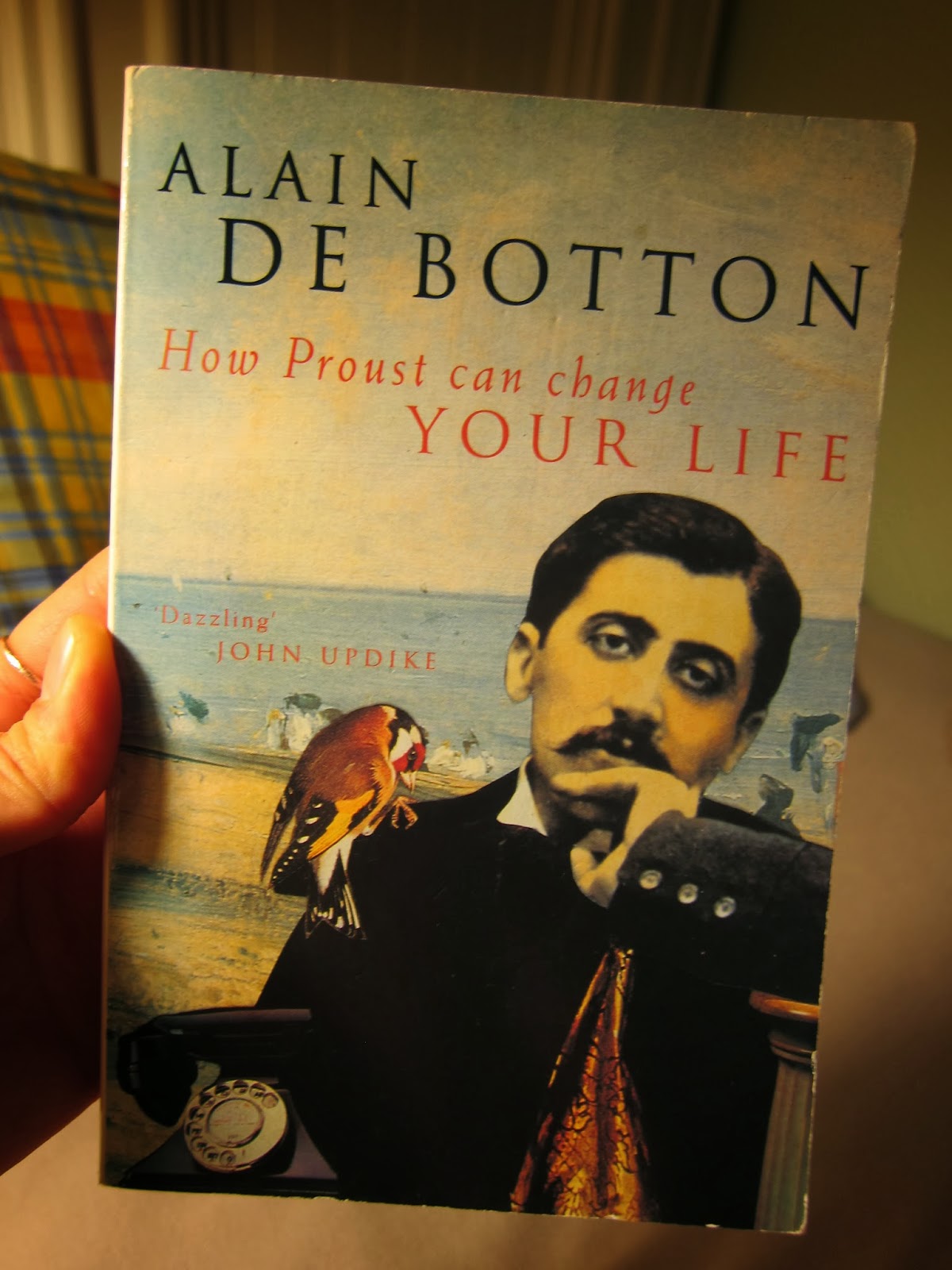
How Proust Can Change Your Life --Alain de Botton
My legs were uncomfortabl(ly warm)e so I slipped them out from under the covers.
Then my teeth were uncomfortabl(ly tight)e in their retainers so those got slipped out, too.
Then my teeth were uncomfortabl(ly tight)e in their retainers so those got slipped out, too.
 |
| the following quotations are from here (what the...there are youtube renditions of this) |
How to Put Books Down:
"...we should be reading for a particular reason: not to pass the time, not out of detached curiosity, but out of a dispassionate wish to find out what Ruskin felt, but because, to repeat with italics, "there is no better way of coming to be aware of what one feels oneself than by trying to recreate in oneself what a master has felt." We should read other people's books in order to learn what we feel; it is our own thoughts we should be developing even if it is another writer's thoughts that help us do so. A fulfilled academic life would therefore require us to judge that the writers we were studying articulated in their books a sufficient range of our own concerns, and that in the act of understanding them through translation or commentary, we would simultaneously be understanding and developing the spiritually significant parts of ourselves.
And therein lay Proust's problem, because in his view, books could not make us aware of enough of the things we felt. They might open our eyes, sensitize us, enhance our powers of perception, but at a certain point they would stop, not by coincidence, not occasionally, not out of bad luck, but inevitably, by definition, for the stark and simple reason that the author wasn't us. There would come a moment with every book when we would feel that something was incongruous, misunderstood, or constraining, and it would give us a responsibility to leave our guide behind and continue our thoughts alone...
It is one of the great and wonderful characteristics of good books (which allow us to see the role at once essential yet limited that reading may play in our spiritual lives) that for the author they may be called "Conclusions" but for the reader "Incitements." We feel very strongly that our own wisdom begins where that of the author leaves off, and we would like him to provide us with answers when all he is able o do is provide us with desires... That is the value of reading, and also its inadequacy. To make it into a discipline is to give too large a role to what is only an incitement. Reading is on the threshold of the spiritual life; it can introduce us to it: it does not constitute it.
It obliges us to read with care, to welcome the insights books give us, but not to subjugate our independence or smother the nuances of our own love life in the process.
Otherwise, we might suffer a range of symptoms that Proust identified in the overreverent, overreliant reader:
.........
Symptom No. 2: That we are unable to write after reading a good book:
Reading Proust nearly silenced Virginia Woolf... "Proust so titillates my own desire for expression that I can hardly set out the sentence. Oh if I could write like that! I cry. And at the moment such is the astonishing vibration and saturation that he procures -- there's something sexual in it -- that I feel I can write like that, and seize my pen and then I can't write like that."
"I detest my own volubility. Why be always spouting words?"
"This is the worst time of all. It makes me suicidal. Nothing seems left to do. All seems insipid and worthless."
"[In Search of Lost Time] which is of course so magnificent that I can't write myself within its arc. For years I've put off finishing it; but now, thinking I may die one of these years, I've returned, and let my own scribble do what it likes. Lord what a hopeless bad book mine will be!"
The tone suggests that Woolf had at last made her peace with Proust. He could have his terrain, she had hers to scribble in. The path from depression and self-loathing to cheerful defiance suggested a gradual recognition that one person's achievements did not have to invalidate another's, that there would always be something left to do even if it momentarily appeared otherwise. Proust might have expressed many things well, but independent thought and the history of the novel had not come to a half with him. His book did not have to be followed by silence; there was still space for the scribbling of others, for Mrs. Dalloway, The Common Reader, A Room of One's Own, and in particular, there was space for what these books symbolized in this context -- perceptions of one's own."
--------------------------------the application:------------------------------
These are layers and layers of genius to grapple with, learn from, and irreverently throw aside after having ingested their healthy juices. As healthy and addictively refreshing as regular bowel movements, a happy colon with a diet full of fiber.
I feel like I am learning how to read from this book. The best kinds of teachers are the ones you can leave behind, aren't they? No matter how good their handwriting, no matter how ingenious their analysis of To the Lighthouse, no matter how inferior you feel in their presence -- actually, the best, the most effective, the most truly inspirational of all teacherly beings are the ones who allow you to stand on their shoulders and look into worlds beyond their own scope. Teachers with teachings that are great enough to cause those heart tremors, but humble enough to allow for the possibility of greater, fiercer vibrations.
Those who equip us with the real tools, of believing in the distinct realizability of our loftiest dreams. In made-up words and over-hyphenization, allll included.
 |
| "Lord what a helpless bad book mine will be!" |
There
are unbreathed, disquieted rumblings on the insides of my insides. I can't wait to read A la recherche de temps perdu. I can't wait to finish it and to put it down and then to poop out my own poop (...sorry; stop thinking about it...now!). But for now, it's legs-under-the-covers and retainers, back on: getting prepared for the good work of tomorrow and tomorrow's tomorrow's tomorrows.
Wednesday, January 8, 2014
travel
여행
-윤성택
여정이 일치하는 그곳에 당신이 있고
길이 생겨나기 시작 한다
시간은 망명과 같다 아무도 그
서사의 끝에서 돌아오지 못한다
그런 끝끝내 완성될 운명이
이렇게 읽히고 있다는 사실,
사랑은 단 한 번 펼친 면의 첫줄에서
비유 된다 이제 더 이상
우연한 방식의 이야기는 없다
이곳에 도착했으니 가방은
조용해지고 마음이 열리기 시작 한다
여행은 항상 당신의 궤도에 있다.
This is just to say
that the tra-
vel bug
is coming
back
and I am
quietly
ecstatic ab
-out this.
Let's go together.
Saturday, December 28, 2013
This is How: part 2
part 1: heaa
from: How to be Confident
"To allow yourself to be "yourself" when you are with others, you don't need to have years of therapy-polished love for yourself - merely tolerance.
When you're on a date or in a meeting or wherever it is you need to be seen as confident or wish you had "confidence," this is the tool to pull from the box and use: be where you are when you're there, doing whatever it is you're doing.
Engage with someone and focus on them, not on your own self, not wondering how focused you are or how much time has passed."
from: How to Shatter Shame
"Some people find it difficult - or impossible - to focus on what they're doing instead of the people watching. Some people struggle and cannot seem to let go of other people's opinions of them, whether real or imagined. That means they're not able to be themselves. Which means other people won't see them as confident.
This is a self-esteem issue.
The phrase "self-esteem issue" is a cardboard stage prop of a phrase. What does it even mean?
I guess I have a hard time believing that anything hyphenated could possibly be the deepest truth of the matter.
A lack of "self-esteem" really suggests a feeling of shame over being one's self.
Shame is the landfill emotion. It's not organic, like joy. It was dumped there by somebody else."
from: How to Get Over Your Addiction to the Past
"For many years, I believed that one's past had to be fully understood in order to move through and beyond it. I see now that I was wrong about this. I know now that scrutinizing one's past and trying to gain understanding and "make peace" with it is a kind of addiction that keeps one focused on the past and not on the present.
The past does not haunt us. We haunt the past. We allow our minds to focus in that direction. We open memories and examine them. We reexperience emotions we felt during the painful events we experienced because we are recalling them in as much detail as we can.
The unfairness of your current status is unimportant. What matters is, can you do what you need to do? If not, what can you do to achieve what you want to achieve?
Denial of the painful events in one's past is the same as obsessing over one's past. To actively refuse to discuss or think about, if need be, what happened is to imbue it with power.
Recycling the past into a new business, a not-for-profit to help others, a workshop, a painting, a book, a song - these are ways to explore the past in the context of the present. These are things people who are actively alive do."
more to come as I read on.
Winter break je t'aime.
Wednesday, March 28, 2012
:E
Ivory Camaraderie
original text: below below
translated by Madison Lee
The pillars of teeth
Rehearse their ferocious geometry,
But they are innocent
Like the white garments of a nun.
They say, “I open, I bite, I chew
If it is the command, I offer help
To the smile in its happy hour
And protect the flavors
In my humid vessel.”
Teeth are comrades,
Brothers in arms
And of harvests.
If one falls, wounded in the soul,
In the rosy gums,
The others are struck with fear
And astonished, crowd together
Leaning to the sides
In a gesture of camaraderie.
Teeth are drums,
Castanets, pealing,
Choirs in which the tongue
Seeks protection or lattice cover.
They are also tremendous weapons,
Knives from the gunsmiths,
Carnivorous drills
In the bloody gums.
Teeth are the witnesses
To the kisses and the dates.
Monks and loyal lovers,
Suicidal seminarians.
Dientes
camaradas
Las columnas
de los dientes
ensayan su
feroz geometría,
pero son
inocentes
como casullas
de monja.
Dicen: “abro,
muerdo, mastico
si es la
consigna, ayudo
a la risa en
su hora dichosa
y protejo los
sabores
en mi húmeda
vasija”.
Los dientes
son camaradas,
compañeros de
armas
y de
vendimias.
Si uno cae,
herido del alma,
en las rosadas
encías,
los otros se
sobrecogen
y en el
estupor se apiñan
inclinados a
los lados
en gesto de
camaradería.
Los dientes
son tamboriles,
castañuelas
que repican,
corales donde
la lengua
busca
protección o celosía.
Son también
armas tremendas,
cuchillos de
las armerías,
trepanadores
carnívoros
de las
sangrientas encías.
Los dientes
son los testigos
de los besos y
las citas.
Monjes y
amantes fieles,
seminaristas
suicidas.
Thursday, March 17, 2011
partial to parcels
Parcels possess potential. A package wrapped in parchment paper, arriving in the pitch-black of a pristine winter night, packed with peanut brittle. A present containing a purple umbrella – protection against the pitter-patter of a rainy day in Pennsylvania. A paperback Pride and Prejudice with a petite pile of post-it notes, for Professor Pavlo's English 101: the personal reading assignment. It can be anything you want it to be, up until the moment you peel back the wrappings – a pleasant surprise, a mysterious perfection.
Parcel pronounces prettily. The perfect elision from the 'par-' to the '-cel' presenting a poetic partnership of syllables paired in auditory heaven; the two separated ever-pining for each other in the most pathetic of parted-lovers' sighs. One without the other is powerless, pitiful, perished. Preposterous perspiration and panic-inducing paralysis of my pulmonary system demonstrate my most profound passion for 'parcel.'
Parcels play phonetically. With so many possibilities for fortunate spelling faux-pas of this divine word, misspelling is probably more profitable than pernicious. Some strikingly pleasant examples: parsley, atop a prodigious portion of steak, for example; a parasol, for protection against the parching blaze of the summer sun; and Parseltongue, resulting from a particularly egregious error leading to the name of a peculiar language spoken by a certain Mr. H. Potter.
Who isn't partial to parcels? They are perfect.
Subscribe to:
Posts (Atom)