Showing posts with label quotes. Show all posts

Tuesday, May 13, 2014

ominous wennsday poem

At the Very Lengthy Meeting


At the very lengthy meeting
I actually felt my soul leave my body
and rush toward the ceiling—
and fly around the walls and flare
toward daylight, toward the windows—
to throw silently its impetuous emptiness
against the glass in vain.
It could not go anywhere, the clear moth.


Then it lay on the rug, not exhausted
but bored and so inert that it almost—
though nothing—
took on a hue, stained with all the breaths
and words and thoughts that filled the room:
the yellow-green color of old teeth.


this isn't foreboding 
at all
on the final wednesday
before 

the rest of my life.

please let me keep my soul.

Monday, May 12, 2014

extremely loud & incredibly close

119 was I worried about her, putting all of her life into her life story, no, I was so happy for her, I remembered the feeling she was feeling, the exhilaration of building the world anew, I heard from behind the door the sounds of creation, the letters pressing into the paper, the pages being pulled from the machine, everything being, for once, better than it was and as good as it could be, everything full of meaning, and then one morning this spring, after years of working in solitude.

130 I press her hand against her heart, and then against my heart, or I touch her forefinger to the mirror, or touch it, quickly, against the hotplate, sometimes I wonder if she knows, I wonder in my Nothingest moments if she's testing me, if she types nonsense all day long, or types nothing at all, just to see what I'll do in response, she wants to know if I love her, that's all anyone wants from anyone else, not love itself but the knowledge that love is there, like new batteries in the flashlight in the emergency kit in the hall closet.

232 When I looked at you, my life made sense. Even the bad things made sense. They were necessary to make you possible.

words by: Jonathan Safran Foer

Friday, April 18, 2014

THE HISTORY OF LOVE

Leo Gursky, pp. 10-11
My heart is weak and unreliable. When I go it will be my heart. I try to burden it as little as possible. If something is going to have an impact, I direct it elsewhere. My gut for example, or my lungs, which might seize up for a moment but have never yet failed to take another breath... Disappointment in myself: right kidney Disappointment of others in me: left kidney. Personal failures: kishkes... When the clocks are turned back and the dark falls before I'm ready, this, for reasons I can't explain, I feel in my wrists. And when I wake up and my fingers are stiff, almost certainly I was dreaming of my childhood... Yesterday I saw a man kicking a dog and I felt it behind my eyes. I don't know what to cal this, a place before tears. The pain of forgetting: spine. The pain of remembering: spine. All the times I have suddenly realized that my parents are dead, even now, it still surprises me, to exist in a world while that which made me has ceased to exist: my knees, it takes half a tube of Ben-Gay and a big production just to bend them. To everything a season, to every time I've woken only to make the mistake of believing for a moment that someone was sleeping beside me: a hemorrhoid. Loneliness: there is no organ than can take it all.
Leo Gursky p.19
The water gurgled in the pipes and splattered out in a burst. I drank some down and then remembered my plant. I've had it for almost ten years. It's barely alive, but it is alive. More brown than green. There are parts that have withered. But still it lives, leaning always to the left. Even when I rotate it so that what faced the sun no longer faces the sun, it stubbornly leans to the left, choosing against physical need in favor of an act of creativity.
Alma Singer, p. 36
2. WHAT I AM NOT
My brother and I used to play a game. I'd point to a chair. "THIS IS NOT A CHAIR," I'd say. Bird would point to a table. "THIS IS NOT A TABLE." "THIS IS NOT A WALL," I'd say. "THAT IS NOT A CEILING." We'd go on like that. "IT IS NOT RAINING OUT." "MY SHOE IS NOT UNTIED!" Bird would yell. I'd point to my elbow. "THIS IS NOT A SCRAPE!" "THAT IS NOT A KETTLE!" "NOT A CUP!" "NOT A SPOON!" "NOT DIRTY DISHES!" We denied whole rooms, years, weathers. Once, at the peak of our shouting, Bird took a deep breath. At the top of his lungs, he shrieked: "I! HAVE NOT! BEEN! UNHAPPY! MY WHOLE! LIFE!" "But you're only seven," I said.
Alma Singer, p. 45
18. MY MOTHER NEVER FELL OUT OF LOVE WITH MY FATHER
She's kept her love for him alive as the summer they first met. In order to do this, she's turned life away. Sometimes she subsists for days on water and air. Being the only known complex life-form to do this, she should have a species named after her. Once Uncle Julian told me how the sculptor and painter Alberto Giacometti said that sometimes just to paint a head you have to give up the whole figure. To paint a leaf, you have to sacrifice the whole landscape. It might seem like you're limiting yourself at first, but after a while you realize that having a quarter-of-an-inch of something you have a better chance of holding on to a certain feeling of the universe than if you pretended to be doing the whole sky.
My mother did not choose a leaf or a head. She chose my father, and to hold on to a certain feeling, she sacrificed the world. 
Alma Singer, p. 61
33. THE HISTORY OF LOVE, CHAPTER 10
During the Age of Glass, everyone believed some part of him or her to be extremely fragile. For some it was a hand, for others a femur, yet others believed it was their noses that were made of glass. The Age of Glass was followed by the Stone Age as an evolutionary corrective, introducing into human relations a new sense of fragility that fostered compassion. This period lasted a relatively short time in the history of love - about a century - until a doctor named Ignacio da Silva hit on the treatment of inviting people to recline on a couch and giving them a bracing smack on the body part in question proving to them the truth. The anatomical illusion that had seemed so real slowly disappeared and -- like so much we no longer need but can't give up --  became vestigial. But from time to time, for reasons that can't always be understood, it surfaces again, suggesting that the Age of Glass, like the Age of Silence, never entirely ended.
...
 That night he went home full of joy. He couldn't sleep, so excited was he for the next day, when he and Alma had a date to go to the movies. He picked her up the following evening and gave her a bunch of yellow daffodils. At the theater, the fought - and triumphed over! - the perils of sitting... When his knees started to shake and he pictured himself lying in splinters of glass, he fought the urge to pull away. He ran his fingers down her spine over her thin blouse, and for a moment he forgot the danger he was in, grateful for the world which purposefully puts divisions in place so that we can overcome them, feeling the joy of getting closer, even if deep down we can never forget the sadness of our insurmountable differences. Before he knew it, he was shaking violently. He seized his muscles to try to stop. Alma felt his hesitation. She leaned back and looked at him with something like hurt, and then he almost but didn't say the two sentences he'd been meaning to say for years: Part of me is made of glass, and also, I love you.
Alma Singer, p.73
"THE AGE OF SILENCE"
During the Age of Silence, people communicated more, not less. Basic survival demanded that the hands were almost never still, and so it was only during sleep (and sometimes not even then) that people were not saying something or other. No distinction was made between the gestures of language and the gestures of life. The labor of building a house, say, or preparing a meal was no less an expression than making the sign for I love you or I feel serious... Naturally, there were misunderstandings. There were times when a finger might have been lifted to scratch a nose, and if casual eye contact was made with one's lover just then, the lover might accidentally take it to be the gesture, not at all dissimilar, for Now I realize I was wrong to love you. These mistakes were heartbreaking. And yet, because people knew how easily they could happen, because they didn't go around with the illusion that they understood perfectly the things other people said, they were used to interrupting each other to ask if they'd understood correctly. Sometimes these misunderstandings were even desirable, since they gave people a reason to say, Forgive me, I was only scratching my nose. Of course I know I've always been right to love you.
If at large gatherings or parties, or around people with whom you feel distant, your hands sometimes hand awkwardly at the ends of your arms -- if you find yourself at a loss for what to do with them, overcome with sadness that comes when you recognize the foreignness of your own body -- it's because your hands remember a time when the division between mind and body, brain and heart, what's inside and what's outside, was so much less. Its not that we've forgotten the language of gestures entirely. The habit of moving our hands while we speak is left over from it. Clapping, pointing, giving the thumbs-up: all artifacts of ancient gestures. Holding hands, for example, is a way to remember how it feels to say nothing together. 
Leo Gursky, p.79
He slid a piece of paper under the door. It said: LIFE IS BUTIFUL. I pushed it back out. He pushed it back in. I pushed it out, he pushed it in Out, in, out, in. I stared at it. LIFE IS BUTIFUL. I thought, Perhaps it is. Perhaps that is the word for life.
Alma Singer, p. 107
13. THE ETERNAL DISAPPOINTMENT OF LIFE AS IT IS
"The Birth of Feeling"
 Having begun to feel, people's desire to feel grew. They wanted to feel more, feel deeper, despite how much it sometimes hurt. People became addicted to feeling. They struggled to uncover new emotions. It's possible that this is how art was born. New kinds of joy were forged, along with new kinds of sadness: The eternal disappointment of life as it is; the relief of unexpected reprieve; the fear of dying. 
Even now, all possible feelings do not yet exist. 
 
Zvi Litvinoff, pp. 157-8
They were standing together, discussing the merits of Grace Kelly's acting versus her unbelievable beauty, when all of a sudden Rosa leaned forward and kissed him. Or at least she tried to kiss him, but Litvinoff, taken off guard, backed away, leaving Rosa tipped forward at an awkward angle, neck outstretched. All night, he'd been monitoring the ebb and flow of distance between their various body parts with growing pleasure. But the shifting measurements had been so fractional that this sudden charge by Rosa's nose almost reduced him to tears. Realizing this mistake, he blindly stuck his neck out into the gulf. But by then, Rosa had already counted her losses and pulled back into safer territory. Litvinoff hung in the balance. Enough time for a waft of Rosa's perfume to tickle his nose, and then he beat a hasty retreat. Or he began to beat a hasty retreat, when Rosa, not wanting to take any more chances, shotput her lips into the contested space, momentarily forgetting that appendage, her nose, which she remembered a fraction of a second later when it collided with Litvinoff's at the instant his lips mashed against hers, so that with their first kiss they became blood relatives. 
Leo Gursky, p. 164
I would have held my son in my arms. I would have told him, Once upon a time you were a fish. A fish? he'd have asked. That's what I'm telling you, a fish. How do you know? Because I was also a fish. You, too? Sure. A long time ago. How long? Long. Anyway, being a fish, you used to know how to swim. I did? Sure. You were a great swimmer. A champion swimmer, you were. You loved the water. Why? What do you mean, why? Why did I love the water? Because it was your life! And as we talked I would have let him go one finger at a time, until, without his realizing, he'd be floating without me. 
Leo Gursky, pp. 238, 240
Once I was hiding in a potato cellar when the SS came. The entrance was hidden by a thin layer of hay. Their footsteps approached, I could hear them speaking as if they were inside my ears. There were two of them. One said, My wife is sleeping with another man, and the other said, How do you know? And the first said, I don't, I only suspect it, to which the second said, Why do you suspect it? while m heart went into cardiac arrest, It's just a feeling, the first said and I imagined the bullet that would enter my brain, I can't think straight, he said, I've lost my appetite completely.
...
Because of that wife who got tired of waiting for her soldier, I lived. All he had to do was poke the hay to discover that there was nothing beneath it; if he hadn't had so much on his mind I'd have been found. Sometimes I wonder what happened to her. I like to imagine the first time she leaned in to kiss that stranger, how she must have felt herself falling for him, or perhaps simply away from her loneliness, and it's like some tiny nothing that sets off a natural disaster halfway across the world, only this was the opposite of disaster, how by accident she saved me with that thoughtless act of grace, and she never knew, and how that, too, is part of the history of love. 

Tuesday, April 15, 2014

everything is nothing is everything is nothing

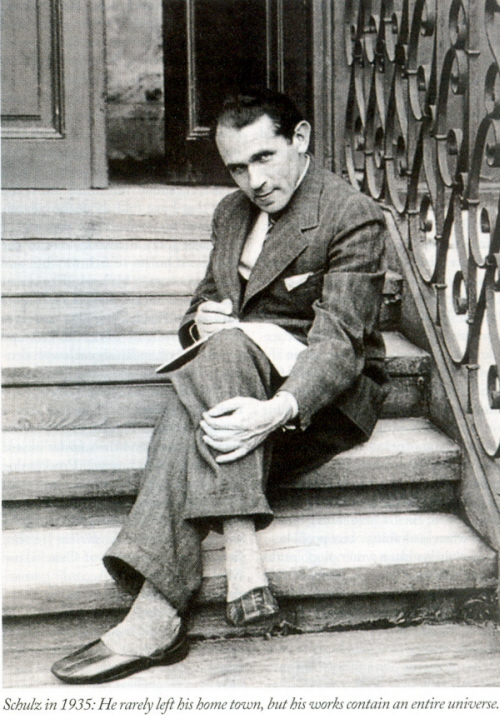
At the moment I am drawn to increasingly inexpressible themes. Paradox, the tension between their vagueness and their evanescence and their universal claim, their aspiration to represent "everything" is the most powerful creative stimulus. I don't know when these stories will be ready for print. An inability to take advantage of bits and scraps of time forces me to set aside their completion until vacation.

April 1939, Schulz, Letters

Thursday, April 10, 2014

schopen-hopen


“The present alone is true and actual; it is the only time which possesses full reality, and our existence lies in it exclusively. Therefore we should always be glad of it, and give it the welcome it deserves, and enjoy every hour that is bearable by its freedom from pain and annoyance with a full consciousness of its value” (92).

For all the pessimism he displays other writings, this bit of advice from Schopenhauer is quite idealistic and hopeful.  His insistence on proper, well-balanced enjoyment of the present definitely rings true with me, especially in one of my personal maxims: “Be where you are.”
                
I spent my third year of undergraduate studies abroad, studying abroad for two semesters in two different locations, sandwiched by two summers abroad.  After the first summer of working in Korea, I spent my fall semester in Seoul, after which I was in Lyon, France for the spring semester.  The summer after this year was spent in Korea as well.  This whole period of time involved a lot of local traveling, too, around East Asia and Europe respectively.  It was during this time that I truly got to live out the value of this phrase that I’d always believed in, as a self-proclaimed “present-lover.”  One piece of advice that people gave me about studying abroad was to avoid “#fomo” – the fear of missing out.  Being abroad means precisely that – you are abroad! – and therefore, not at home.  Inevitably, you “miss out” on people’s lives back home, back at school, back on your side of the globe.  Friends experience things without you, traditions trudge on without you, relationships grow on without you.  And studying abroad, of course, is an experience that opens your eyes to alternate worlds going on all around you all the time.  There’s no way to have all the experiences.  You are limited in a vast, seemingly unlimited world, and all you can fully do is “Be where you are.”


The same is true of those alternative worlds in time.  As with alternative places, those alternative realities of the past and the future can’t ever compete with the reality of the present – “The present alone is true and actual… Therefore we should always be glad of it…with a full consciousness of its value.” Be where you are, when you are.

Tuesday, April 8, 2014

My Symphony

To live content with small means; to seek elegance rather than luxury, and refinement rather than fashion; to be worthy, not respectable, and wealthy, not rich; to study hard, think quietly, talk gently, act frankly; to listen to stars and birds, to babes and sages, with open heart; to bear all cheerfully, do all bravely, await occasions, hurrying never. In a word, to let the spiritual, unbidden and unconscious, grow up through the common. This is to be my symphony.

Thursday, April 3, 2014

meditations on the messiah

from Cynthia Ozick's  The Messiah of Stockholm
he was the messiah and he wasn't. risen from some dead, blessed, and cursed. his father was the most elaborate figment of his imagination; his sister was a fake. stars that mirror one another; windows that pour puddles of life-giving light squares onto the hardwood floor. books that become the saving grace of a town -- only to break down [clangings and clatterings] into the birth of a tiny, hope-brimming bird with a piece of hay in its fragile beak.


edit: 4/9/14 nope Jesus did not have a sister; different messiah hehehoho

Wednesday, April 2, 2014

call and response

My attempts at writing are really agonizing...
I am in the lowest possible spirits. I have been telling myself I am neither a painter nor a writer, I am not even a decent teacher. It seems to me I have been swindling the world by some sort of flash or glitter when there is nothing inside me. I tried to renounce creativity and live like an average person, but this feels very sad.
B Schulz (15 November 1936, Letters, 140) 
Today, I can say that Schulz's writing showed me a way to write about the Shoah, and, in a sense, also a way to live after the Shoah. Sometimes there are such moments of grace: you open a book by an author you don't know, and suddenly you feel yourself passing through a magnetic field that sends you in a new direction, setting off eddies that you'd barely sensed before and could not name. I read Schulz's stories and felt the gush of life. On every page, life was raging, exploding with vitality, suddenly worthy of consciousness and subconsciousness, in dreams, in illusions, and in nightmares. I felt the stories' ability to revive me, to carry me beyond the paralysis and despair that inevitably gripped me whenever I thought about the Holocaust or came into contact with the aspects of human nature which had ultimately allowed it to happen.
David Grossman, The Age of Genius 

Monday, March 31, 2014

The Great Sin

Pride gets no pleasure out of having something, only out of having more of it than the next man. We say that people are proud of being rich, or clever, or good-looking, but they are not. They are proud of being richer, or cleverer, or better-looking than others.

Nearly all those evils in the world which people put down to greed or selfishness are really far more the result of Pride.

Other vices may sometimes bring people together: you may find good fellowship and jokes and friendliness among drunken people or unchaste people. But pride always means enmity - it is enmity. And not only enmity between man and man, but enmity to God.

In God you come up against something which is in every respect immeasurably superior to yourself. Unless you know God as that - and, therefore, know yourself as nothing in comparison - you do not know God at all. As long as you are proud you cannot know God. A proud man is always looking down on things and people: and, of course, as long as you are looking down, you cannot see something that is above you.

That raises a terrible question. How is it that people who are quite obviously eaten up with Pride can say they believe in God and appear to themselves very religious? I am afraid it means they are worshiping an imaginary God. They theoretically admit themselves to be nothing in the presence of this phantom God, but are really all the time imagining how He approves of them and think them far better than ordinary people...
Mere Christianity, C.S. Lewis pp.122-124

Sunday, March 30, 2014

unconventional, excellent advice

There are many paths. Don't fret if you don't see yours quite so clearly yet. You might be forging one unique to you.

Someone is always there for you to talk to. This means prayer. It's all about balance. Just cause you label yourself an introvert doesn't mean you opt out of being with other people. What makes you feel most human, anyway?

"This is water."


This is Water from Patrick Buckley on Vimeo.


Stop asking "what if
"We do not have to grope about blindly in prayer hoping we hit some cosmic bullseye called God’s will. We are freed to ask, “Will this decision allow me to participate more fully in God’s redemptive work in this world?” This lends tremendous freedom when it comes to making choices and doing God’s will."