119 was I worried about her, putting all of her life into her life story, no, I was so happy for her, I remembered the feeling she was feeling, the exhilaration of building the world anew, I heard from behind the door the sounds of creation, the letters pressing into the paper, the pages being pulled from the machine, everything being, for once, better than it was and as good as it could be, everything full of meaning, and then one morning this spring, after years of working in solitude.
130 I press her hand against her heart, and then against my heart, or I touch her forefinger to the mirror, or touch it, quickly, against the hotplate, sometimes I wonder if she knows, I wonder in my Nothingest moments if she's testing me, if she types nonsense all day long, or types nothing at all, just to see what I'll do in response, she wants to know if I love her, that's all anyone wants from anyone else, not love itself but the knowledge that love is there, like new batteries in the flashlight in the emergency kit in the hall closet.
232 When I looked at you, my life made sense. Even the bad things made sense. They were necessary to make you possible.
words by: Jonathan Safran Foer
Showing posts with label notes on writing. Show all posts
Showing posts with label notes on writing. Show all posts
Monday, May 12, 2014
extremely loud & incredibly close

Tuesday, April 29, 2014
Rails
by Scott Owens
Every child should have one, a pair, really,
a matched set, set apart just the right width
so that one foot pressed against each one
leaves you stretched out about as far
as you can go, unable to move, feeling
almost trapped, almost actually in danger.
And every child should walk them as if
that's what they were intended for,
leading out of town, around the curve,
along the river, revealing the backsides
of people's homes, clotheslines and refuse,
the yards you weren't supposed to see.
And every child should learn to balance
atop the railhead without the constant
unsightly tipping from side to side,
should be able to step exactly the distance
between the ties consistently, almost
marching without kicking up ballast.
And every child should have a bridge
they go under to hide and look
at dirty magazines and smoke cigarettes
and place coins on the rails to flatten
and see if this could be the one
to cause the train to leap the tracks.
And every child should know the lonely
distant sound of late night travel
when bad dreams have kept them awake
wondering where they come from, what
they bring or take, and where when it's all
done they might return and call home.
Friday, April 25, 2014
[is it absurd and audacious to say (i think) i write like this]
[i carry your heart with me(i carry it in]
i carry your heart with me(i carry it in
my heart)i am never without it(anywhere
i go you go,my dear;and whatever is done
by only me is your doing,my darling)
i fear
no fate(for you are my fate,my sweet)i want
no world(for beautiful you are my world,my true)
and it’s you are whatever a moon has always meant
and whatever a sun will always sing is you
here is the deepest secret nobody knows
(here is the root of the root and the bud of the bud
and the sky of the sky of a tree called life;which grows
higher than soul can hope or mind can hide)
and this is the wonder that's keeping the stars apart
i carry your heart(i carry it in my heart)
Friday, April 18, 2014
THE HISTORY OF LOVE
Leo Gursky, pp. 10-11
My heart is weak and unreliable. When I go it will be my heart. I try to burden it as little as possible. If something is going to have an impact, I direct it elsewhere. My gut for example, or my lungs, which might seize up for a moment but have never yet failed to take another breath... Disappointment in myself: right kidney Disappointment of others in me: left kidney. Personal failures: kishkes... When the clocks are turned back and the dark falls before I'm ready, this, for reasons I can't explain, I feel in my wrists. And when I wake up and my fingers are stiff, almost certainly I was dreaming of my childhood... Yesterday I saw a man kicking a dog and I felt it behind my eyes. I don't know what to cal this, a place before tears. The pain of forgetting: spine. The pain of remembering: spine. All the times I have suddenly realized that my parents are dead, even now, it still surprises me, to exist in a world while that which made me has ceased to exist: my knees, it takes half a tube of Ben-Gay and a big production just to bend them. To everything a season, to every time I've woken only to make the mistake of believing for a moment that someone was sleeping beside me: a hemorrhoid. Loneliness: there is no organ than can take it all.
Leo Gursky p.19
The water gurgled in the pipes and splattered out in a burst. I drank some down and then remembered my plant. I've had it for almost ten years. It's barely alive, but it is alive. More brown than green. There are parts that have withered. But still it lives, leaning always to the left. Even when I rotate it so that what faced the sun no longer faces the sun, it stubbornly leans to the left, choosing against physical need in favor of an act of creativity.
Alma Singer, p. 36
2. WHAT I AM NOT
My brother and I used to play a game. I'd point to a chair. "THIS IS NOT A CHAIR," I'd say. Bird would point to a table. "THIS IS NOT A TABLE." "THIS IS NOT A WALL," I'd say. "THAT IS NOT A CEILING." We'd go on like that. "IT IS NOT RAINING OUT." "MY SHOE IS NOT UNTIED!" Bird would yell. I'd point to my elbow. "THIS IS NOT A SCRAPE!" "THAT IS NOT A KETTLE!" "NOT A CUP!" "NOT A SPOON!" "NOT DIRTY DISHES!" We denied whole rooms, years, weathers. Once, at the peak of our shouting, Bird took a deep breath. At the top of his lungs, he shrieked: "I! HAVE NOT! BEEN! UNHAPPY! MY WHOLE! LIFE!" "But you're only seven," I said.
Alma Singer, p. 45
18. MY MOTHER NEVER FELL OUT OF LOVE WITH MY FATHER
She's kept her love for him alive as the summer they first met. In order to do this, she's turned life away. Sometimes she subsists for days on water and air. Being the only known complex life-form to do this, she should have a species named after her. Once Uncle Julian told me how the sculptor and painter Alberto Giacometti said that sometimes just to paint a head you have to give up the whole figure. To paint a leaf, you have to sacrifice the whole landscape. It might seem like you're limiting yourself at first, but after a while you realize that having a quarter-of-an-inch of something you have a better chance of holding on to a certain feeling of the universe than if you pretended to be doing the whole sky.
My mother did not choose a leaf or a head. She chose my father, and to hold on to a certain feeling, she sacrificed the world.
Alma Singer, p. 61
33. THE HISTORY OF LOVE, CHAPTER 10
During the Age of Glass, everyone believed some part of him or her to be extremely fragile. For some it was a hand, for others a femur, yet others believed it was their noses that were made of glass. The Age of Glass was followed by the Stone Age as an evolutionary corrective, introducing into human relations a new sense of fragility that fostered compassion. This period lasted a relatively short time in the history of love - about a century - until a doctor named Ignacio da Silva hit on the treatment of inviting people to recline on a couch and giving them a bracing smack on the body part in question proving to them the truth. The anatomical illusion that had seemed so real slowly disappeared and -- like so much we no longer need but can't give up -- became vestigial. But from time to time, for reasons that can't always be understood, it surfaces again, suggesting that the Age of Glass, like the Age of Silence, never entirely ended.
...
That night he went home full of joy. He couldn't sleep, so excited was he for the next day, when he and Alma had a date to go to the movies. He picked her up the following evening and gave her a bunch of yellow daffodils. At the theater, the fought - and triumphed over! - the perils of sitting... When his knees started to shake and he pictured himself lying in splinters of glass, he fought the urge to pull away. He ran his fingers down her spine over her thin blouse, and for a moment he forgot the danger he was in, grateful for the world which purposefully puts divisions in place so that we can overcome them, feeling the joy of getting closer, even if deep down we can never forget the sadness of our insurmountable differences. Before he knew it, he was shaking violently. He seized his muscles to try to stop. Alma felt his hesitation. She leaned back and looked at him with something like hurt, and then he almost but didn't say the two sentences he'd been meaning to say for years: Part of me is made of glass, and also, I love you.
Alma Singer, p.73
"THE AGE OF SILENCE"
During the Age of Silence, people communicated more, not less. Basic survival demanded that the hands were almost never still, and so it was only during sleep (and sometimes not even then) that people were not saying something or other. No distinction was made between the gestures of language and the gestures of life. The labor of building a house, say, or preparing a meal was no less an expression than making the sign for I love you or I feel serious... Naturally, there were misunderstandings. There were times when a finger might have been lifted to scratch a nose, and if casual eye contact was made with one's lover just then, the lover might accidentally take it to be the gesture, not at all dissimilar, for Now I realize I was wrong to love you. These mistakes were heartbreaking. And yet, because people knew how easily they could happen, because they didn't go around with the illusion that they understood perfectly the things other people said, they were used to interrupting each other to ask if they'd understood correctly. Sometimes these misunderstandings were even desirable, since they gave people a reason to say, Forgive me, I was only scratching my nose. Of course I know I've always been right to love you.
If at large gatherings or parties, or around people with whom you feel distant, your hands sometimes hand awkwardly at the ends of your arms -- if you find yourself at a loss for what to do with them, overcome with sadness that comes when you recognize the foreignness of your own body -- it's because your hands remember a time when the division between mind and body, brain and heart, what's inside and what's outside, was so much less. Its not that we've forgotten the language of gestures entirely. The habit of moving our hands while we speak is left over from it. Clapping, pointing, giving the thumbs-up: all artifacts of ancient gestures. Holding hands, for example, is a way to remember how it feels to say nothing together.
Alma Singer, p. 107
13. THE ETERNAL DISAPPOINTMENT OF LIFE AS IT IS
"The Birth of Feeling"
Having begun to feel, people's desire to feel grew. They wanted to feel more, feel deeper, despite how much it sometimes hurt. People became addicted to feeling. They struggled to uncover new emotions. It's possible that this is how art was born. New kinds of joy were forged, along with new kinds of sadness: The eternal disappointment of life as it is; the relief of unexpected reprieve; the fear of dying.
Even now, all possible feelings do not yet exist.
Zvi Litvinoff, pp. 157-8
They were standing together, discussing the merits of Grace Kelly's acting versus her unbelievable beauty, when all of a sudden Rosa leaned forward and kissed him. Or at least she tried to kiss him, but Litvinoff, taken off guard, backed away, leaving Rosa tipped forward at an awkward angle, neck outstretched. All night, he'd been monitoring the ebb and flow of distance between their various body parts with growing pleasure. But the shifting measurements had been so fractional that this sudden charge by Rosa's nose almost reduced him to tears. Realizing this mistake, he blindly stuck his neck out into the gulf. But by then, Rosa had already counted her losses and pulled back into safer territory. Litvinoff hung in the balance. Enough time for a waft of Rosa's perfume to tickle his nose, and then he beat a hasty retreat. Or he began to beat a hasty retreat, when Rosa, not wanting to take any more chances, shotput her lips into the contested space, momentarily forgetting that appendage, her nose, which she remembered a fraction of a second later when it collided with Litvinoff's at the instant his lips mashed against hers, so that with their first kiss they became blood relatives.
Leo Gursky, p. 164
I would have held my son in my arms. I would have told him, Once upon a time you were a fish. A fish? he'd have asked. That's what I'm telling you, a fish. How do you know? Because I was also a fish. You, too? Sure. A long time ago. How long? Long. Anyway, being a fish, you used to know how to swim. I did? Sure. You were a great swimmer. A champion swimmer, you were. You loved the water. Why? What do you mean, why? Why did I love the water? Because it was your life! And as we talked I would have let him go one finger at a time, until, without his realizing, he'd be floating without me.
Leo Gursky, pp. 238, 240
Once I was hiding in a potato cellar when the SS came. The entrance was hidden by a thin layer of hay. Their footsteps approached, I could hear them speaking as if they were inside my ears. There were two of them. One said, My wife is sleeping with another man, and the other said, How do you know? And the first said, I don't, I only suspect it, to which the second said, Why do you suspect it? while m heart went into cardiac arrest, It's just a feeling, the first said and I imagined the bullet that would enter my brain, I can't think straight, he said, I've lost my appetite completely.
...
Because of that wife who got tired of waiting for her soldier, I lived. All he had to do was poke the hay to discover that there was nothing beneath it; if he hadn't had so much on his mind I'd have been found. Sometimes I wonder what happened to her. I like to imagine the first time she leaned in to kiss that stranger, how she must have felt herself falling for him, or perhaps simply away from her loneliness, and it's like some tiny nothing that sets off a natural disaster halfway across the world, only this was the opposite of disaster, how by accident she saved me with that thoughtless act of grace, and she never knew, and how that, too, is part of the history of love.
Tuesday, April 15, 2014
everything is nothing is everything is nothing
At the moment I am drawn to increasingly inexpressible themes. Paradox, the tension between their vagueness and their evanescence and their universal claim, their aspiration to represent "everything" is the most powerful creative stimulus. I don't know when these stories will be ready for print. An inability to take advantage of bits and scraps of time forces me to set aside their completion until vacation.
April 1939, Schulz, Letters
Wednesday, April 2, 2014
call and response
My attempts at writing are really agonizing...
I am in the lowest possible spirits. I have been telling myself I am neither a painter nor a writer, I am not even a decent teacher. It seems to me I have been swindling the world by some sort of flash or glitter when there is nothing inside me. I tried to renounce creativity and live like an average person, but this feels very sad.
B Schulz (15 November 1936, Letters, 140)
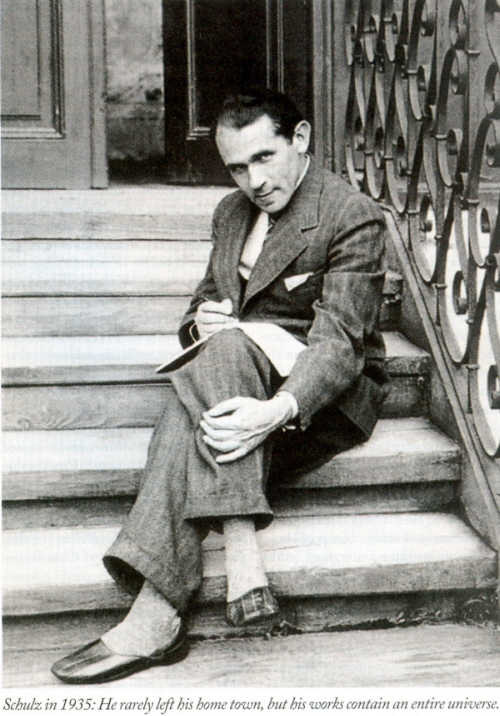
Today, I can say that Schulz's writing showed me a way to write about the Shoah, and, in a sense, also a way to live after the Shoah. Sometimes there are such moments of grace: you open a book by an author you don't know, and suddenly you feel yourself passing through a magnetic field that sends you in a new direction, setting off eddies that you'd barely sensed before and could not name. I read Schulz's stories and felt the gush of life. On every page, life was raging, exploding with vitality, suddenly worthy of consciousness and subconsciousness, in dreams, in illusions, and in nightmares. I felt the stories' ability to revive me, to carry me beyond the paralysis and despair that inevitably gripped me whenever I thought about the Holocaust or came into contact with the aspects of human nature which had ultimately allowed it to happen.
David Grossman, The Age of Genius
Tuesday, March 25, 2014
that pure poetry of fruit
On those luminous mornings Adela returned from the market, like Pomona emerging from the flames of day, spilling from her basket the colorful beauty of the sun -- the shiny pink cherries full of juice under their transparent skins, the mysterious black morellos that smelled so much better than they tasted; apricots in whose golden pulp lay the core of long afternoons. And next to that pure poetry of fruit, she unloaded sides of meat with their keyboard of ribs swollen with energy and strength, and seaweeds of vegetables like dead octopuses and squids -- the raw material of meals with a yet undefined taste, the vegetative and terrestrial ingredients of dinner, exuding a wild and rustic smell.
Bruno Schulz, The Street of Crocodiles, p.25
Thursday, March 20, 2014
THE STREET OF CROCODILES_SCHULZ_ INTRODUCTION BY FICOWSKI
Lacking the courage to address readers, he tried at first to write for a reader, a recipient of his letters. When at last, around 1930, he found a partner for this exchange in the person of Deborah Vogel, a poet and doctor of philosophy who lived in Lvov, his letters -- even then often masterpieces of the epistolary art -- underwent a metamorphosis, becoming daring fragments of dazzling prose. His correspondent, greatly excited, urged him to continue. It was in this way, letter by letter, piece by piece, that The Street of Crocodiles came into being, a literary work enclosed a few pages at a time in envelopes and dropped into the mailbox.
Wednesday, March 12, 2014
how to begin a story; how to learn; how to grow
THE FORMLESS VOID (Mendelsohn, chapter 2)
...the issue that Friedman is interested in having his readers understand is, in essence, a writer's issue: How do you begin a story? For Friedman, the opening of Bereishit brings to mind a technique we all know from the movies: "Like some films that begin with a sweeping shot that then narrows," he writes, "so the first chapter of Genesis moves gradually from a picture of the skies and earth down to the first man and woman. The story's focus will continue to narrow: from the universe to the earth to humankind to specific lands and people's to a single family." And yet, he reminds his readers, the wider, cosmic concerns of the world-historical story that the Torah tells will remain in the back of our minds as we read on, providing the rich substratum of meaning that gives such depth to that family's story.
Friedman's observation implies, as is certainly true, that often it is the small things, rather than the big picture, that the mind can comfortably grasp: that, for instance, it is naturally more appealing to readers to absorb the meaning of a vast historical event through the story of a single family.
CREATION (Mendelsohn, chapter 1)
To my mind, this progress from ruin to correction is intimately connected to the nature of knowledge itself, which is, at best, a process: from ignorance to awareness, from intellectual "ruin" to its "correction," from indistinct chaos to orderly scholarship. Knowledge, therefore encompasses at once the starting point, which is empty, harmful, painful, and the end point, which is pleasure. To my mind it is this quality of process, of development, which can only take place over time, that answers, finally, the question of why Knowledge must come from a tree. For a tree is a thing that grows; and growth, like learning, can only happen over and through time itself. Indeed, outside the medium of time, words like "grow" and "learn" cannot have any meaning at all.
 |
| tree of knowledge |
Wednesday, March 5, 2014
"Nothing would ever get me to leave here."
from The Plot Against America (207), Philip Roth
Since about three it had been squalling steadily, but abruptly the wind-driven downpour stopped and the sun came blazing our as though the clocks had been turned ahead and, over in the west, tomorrow morning was now set to begin at six p.m. today. How could a street as modest as ours induce such rapture just because it glittered with rain? How could the sidewalk's impassable leaf-strewn lagoons and the grassy little yards oozing from he flood of the downspouts exude a smell that roused my delight as if I'd been born in a tropical rain forest? Tinged with the bright after-storm light, Summit Avenue was as agleam with life as a pet, my own silky, pulsating pet, washed clean by sheets of falling water and now stretched its full length to bask in the bliss.A nine-year-old love rhapsody for his home-street; it's more grown-up and luscious than anything, there's nothing nine-year-old about it. This is the power of Roth's prose, ebbing and flowing between childhood and grownupness, between the pungent rapture of New Jersey rain forests and silky, pulsating pet-lives concerning no puppies, no kittens, no scaly reptiles at all.
Subscribe to:
Posts (Atom)