Showing posts with label english major. Show all posts

Thursday, April 10, 2014

schopen-hopen


“The present alone is true and actual; it is the only time which possesses full reality, and our existence lies in it exclusively. Therefore we should always be glad of it, and give it the welcome it deserves, and enjoy every hour that is bearable by its freedom from pain and annoyance with a full consciousness of its value” (92).

For all the pessimism he displays other writings, this bit of advice from Schopenhauer is quite idealistic and hopeful.  His insistence on proper, well-balanced enjoyment of the present definitely rings true with me, especially in one of my personal maxims: “Be where you are.”
                
I spent my third year of undergraduate studies abroad, studying abroad for two semesters in two different locations, sandwiched by two summers abroad.  After the first summer of working in Korea, I spent my fall semester in Seoul, after which I was in Lyon, France for the spring semester.  The summer after this year was spent in Korea as well.  This whole period of time involved a lot of local traveling, too, around East Asia and Europe respectively.  It was during this time that I truly got to live out the value of this phrase that I’d always believed in, as a self-proclaimed “present-lover.”  One piece of advice that people gave me about studying abroad was to avoid “#fomo” – the fear of missing out.  Being abroad means precisely that – you are abroad! – and therefore, not at home.  Inevitably, you “miss out” on people’s lives back home, back at school, back on your side of the globe.  Friends experience things without you, traditions trudge on without you, relationships grow on without you.  And studying abroad, of course, is an experience that opens your eyes to alternate worlds going on all around you all the time.  There’s no way to have all the experiences.  You are limited in a vast, seemingly unlimited world, and all you can fully do is “Be where you are.”


The same is true of those alternative worlds in time.  As with alternative places, those alternative realities of the past and the future can’t ever compete with the reality of the present – “The present alone is true and actual… Therefore we should always be glad of it…with a full consciousness of its value.” Be where you are, when you are.

Wednesday, April 2, 2014

call and response

My attempts at writing are really agonizing...
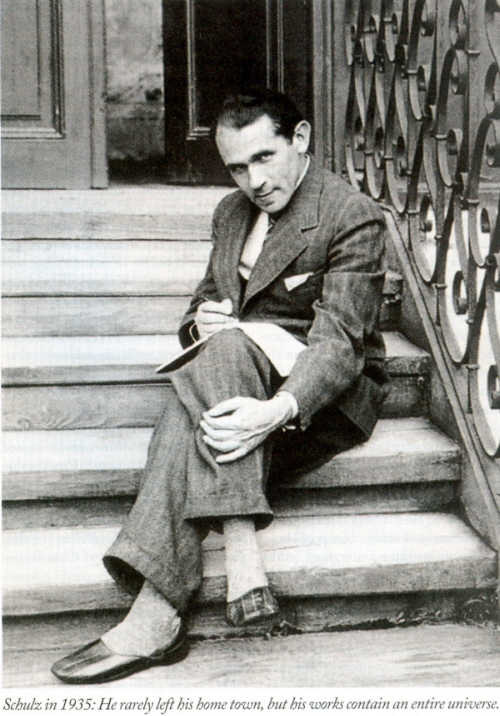
I am in the lowest possible spirits. I have been telling myself I am neither a painter nor a writer, I am not even a decent teacher. It seems to me I have been swindling the world by some sort of flash or glitter when there is nothing inside me. I tried to renounce creativity and live like an average person, but this feels very sad.
B Schulz (15 November 1936, Letters, 140) 
Today, I can say that Schulz's writing showed me a way to write about the Shoah, and, in a sense, also a way to live after the Shoah. Sometimes there are such moments of grace: you open a book by an author you don't know, and suddenly you feel yourself passing through a magnetic field that sends you in a new direction, setting off eddies that you'd barely sensed before and could not name. I read Schulz's stories and felt the gush of life. On every page, life was raging, exploding with vitality, suddenly worthy of consciousness and subconsciousness, in dreams, in illusions, and in nightmares. I felt the stories' ability to revive me, to carry me beyond the paralysis and despair that inevitably gripped me whenever I thought about the Holocaust or came into contact with the aspects of human nature which had ultimately allowed it to happen.
David Grossman, The Age of Genius 

Thursday, March 27, 2014

What does your ideal meal look like? -sunshine & sandwiches-

a summer picnic

a summer picnic with no pesky bugs (unpesky ones welcome)

a summer picnic with no pesky bugs, and a fresh, summery breeze that sweeps away extra deposits of sunshine just as you're about to get "too" anything, no sweating allowed unless you wanna run around and throw around a frisbee except not frisbees because those always come over and hit me on the head.

a summer picnic with no pesky bugs, and a fresh, summery breeze that sweeps away extra deposits of sunshine just as you're about to get "too" anything, and simple, but filling food (maybe sandwiches; homemade multi-grain bread, freshly-sliced deli meats, AWL the cheeses from France, whole-grain mustard = KEY; sweet potato fries, somehow still warm from the fryer; all kinds of FRUIT, gathered from trees/bushes/the earth [somehow now we are in an orchard. or there's an orchard nearby, ~14 minute walk]; some kind of CAKE, no nuts except maybe hazelnuts except okay maybe half and half, for the nut-averse/nut-endangered... etc. but the food is not truly the point)

a summer picnic with no pesky bugs, and a fresh, summery breeze that sweeps away extra deposits of sunshine just as you're about to get "too" anything,  and simple, but filling food, on well-worn but clean, bright, perfectly sized picnic blankets that make us all sit kind of close to each other but not too crowdedly (the US is unforeseen, and this is the beauty of it all. a picnic of unexpectedly, unplannedly perfect group of thinkers, talkers, feelers, friends and strangers, coming together for various good and terrible reasons such as 1. car has broken down right next to the picnic, 2. you are looking for a lost pet gerbil in the field, 3. you started the picnic, etc.)

a summer picnic with no pesky bugs, and a fresh, summery breeze that sweeps away extra deposits of sunshine just as you're about to get "too" anything,  and simple, but filling food, on well-worn but clean, bright, perfectly sized picnic blankets that make us all sit kind of close to each other but not too crowdedly, in which the WE feelings are high and triumphant but inclusive and loving and YOU can join, too. 

a summer picnic. with sunshine & sandwiches. with you. and the blanket doesn't even have to be plaid.

Thursday, March 20, 2014

THE STREET OF CROCODILES_SCHULZ_ INTRODUCTION BY FICOWSKI

Lacking the courage to address readers, he tried at first to write for a reader, a recipient of his letters. When at last, around 1930, he found a partner for this exchange in the person of Deborah Vogel, a poet and doctor of philosophy who lived in Lvov, his letters -- even then often masterpieces of the epistolary art -- underwent a metamorphosis, becoming daring fragments of dazzling prose. His correspondent, greatly excited, urged him to continue. It was in this way, letter by letter, piece by piece, that The Street of Crocodiles came into being, a literary work enclosed a few pages at a time in envelopes and dropped into the mailbox.

Thursday, March 13, 2014

"oy vey"s & in-advance hallelujahs

“The case for the humanities is not hard to make, though it can be difficult--to such an extent have we been marginalized, so long have we acceded to that marginalization--not to sound either defensive or naive. The humanities, done right, are the crucible within which our evolving notions of what it means to be fully human are put to the test; they teach us, incrementally, endlessly, not what to do but how to be. Their method is confrontational, their domain unlimited, their "product" not truth but the reasoned search for truth, their "success" something very much like Frost's momentary stay against confusion.”
― Mark Slouka

This year, for the first time in at least a very long time (perhaps since the beginning of things), the English department's graduation ceremony will not be held on the Lawn. It's historic and subtle at the same time, significant and sort of sneaky, because they're just shifting us over to the amphitheater - arguably just as central to the university grounds and just as appropriate for the values of the English major. "We deal with theater, too," my Jewish lit professor said, a little dejectedly.

I guess... But let's be real. She was just as unconvinced as I am about the okayness of this whole Lawn --> Amphitheater shift. It's not the same.

The sand dunes of education have been changing, bit by bit, one wind drift after another, displacing mountains of sand and creating brand new ones elsewhere, subtly but certainly changing the landscape of the humanities. It's hugely symbolic, this change, and merely symptomatic of the undercurrents of change rushing beneath the surface. We've forgotten how to value the humanities. What about the renaissance man ideal? What about the Grand Tour? I feel like I was born in the wrong century. But if that could somehow be rectified, I would be the wrong gender. Oy vey.

It's disturbing, but maybe that's only because I happen to be on this side of the demarcation. The "wrong side," outdated and marginalized because those are the rules of society today, just as the merchants and craftsmen must have felt in the days of those bougie renaissance men who got to travel all over Europe in their privileged, bougie, fancypantsy lives. And it would be too blindly simplistic to just stomp my left foot in indignation at the loss of humanity!!!!!1 and the deplorable values!!! of our society, because you've gotta give credit to those responsible, productive-members-of-society-to-be for wanting to make themselves marketable. To become employed someday and earn the moneys. To provide for their future families and their future families.

They might even be closet poetry lovers; martyrs, in a sense, led to the sacrificial pyre of our failing economy, burning bright with the irresistible aura of Wall Street, beckoning us like helpless moths toward those cruel but effective zappy summer camp lights, and the grinding machinations of our Society of Productivity. It's all complicated.

All I know is that the Comm school has the plushiest of chairs, and I did not choose to study anything remotely related to money and other potentially depressing things.

But still, while I mourn for the loss of the English department's fight for the Lawn during that epic ceremony of the class of 2014, I am also at peace. Our growing obsession with money wasn't anything unanticipated by Jesus. Just google yourself a favor and ask the internet: "how many verses about money in the bible." We are so predictable, and that's weirdly reassuring.

This probably explains why I am more excited than scared for that insane, forever-anticipated May date when my formal education officially ends (for now), and life as I know it will veer crazily off its track of predictable year-after-years of being a ____-grader. I will no longer be defined by the number of years I've been in school, and hopefully also by other numbers, too, though I hear that's a little more persistent of a problem (SAT scores... GPA... GREs... salary... the numbers don't end).

As of now, March 13th 2014, life after May something 2014 is a void, in many senses - I will no longer have that "occupation" as Full-Time Student, will no longer be "going to UVA," will no longer "be" an English major; all these things will have been relegated to past-tense realities. But at the same time, many things continue: ever a follower of Christ, a child of God, a daughter to my parents and sister to my sister, there are lots of things to find my identity in.

So in this moment, I take delight in the adventuresome excitement of the blankness. "That's pretty hard, being excited about uncertainty," someone said to me a little while back, when I was gushing (not rully) about the exciting combination of not having a job + graduating in a few months. But I dunno -- I am okay. I'm doing okay. Praise God for that, because even this momentary sanity is because of the fact that in him all things hold together. Every second of normalcy and sanity is a paradox and a miracle.

As will be the moment when I do finally get a job or something. Miracle indeed. In-advance Hallelujahs abound.

Wednesday, March 5, 2014

"Nothing would ever get me to leave here."

from The Plot Against America (207), Philip Roth
Since about three it had been squalling steadily, but abruptly the wind-driven downpour stopped and the sun came blazing our as though the clocks had been turned ahead and, over in the west, tomorrow morning was now set to begin at six p.m. today. How could a street as modest as ours induce such rapture just because it glittered with rain? How could the sidewalk's impassable leaf-strewn lagoons and the grassy little yards oozing from he flood of the downspouts exude a smell that roused my delight as if I'd been born in a tropical rain forest? Tinged with the bright after-storm light, Summit Avenue was as agleam with life as a pet, my own silky, pulsating pet, washed clean by sheets of falling water and now stretched its full length to bask in the bliss.
A nine-year-old love rhapsody for his home-street; it's more grown-up and luscious than anything, there's nothing nine-year-old about it. This is the power of Roth's prose, ebbing and flowing between childhood and grownupness, between the pungent rapture of New Jersey rain forests and silky, pulsating pet-lives concerning no puppies, no kittens, no scaly reptiles at all.

Tuesday, March 4, 2014

Thank you God for Emergencies in PAVS 4500

and again

The power of fiction is to create empathy. It lifts you away from your chair and stuffs you gently down inside someone else's point of view... A newspaper could tell you that one hundred people, say, in an airplane, or in Israel, or in Iraq, have died today. And you can think to yourself, "How very sad," then turn the page and see how the Wildcats fared. But a novel could take just one of those hundred lives and show you exactly how it felt to be that person rising from bed in the morning, watching the desert light on the tile of her doorway and on the curve of her daughter's cheek. You could taste that person's breakfast, and love her family, and sort through her worries as your own, and know that a death in that household will be the end of the only life that someone will ever have. As important as yours. As important as mine.

from "High Tide in Tucson" -Barbara Kingsolver

Friday, February 28, 2014

growing up &whatevers

I wonder if "growing up" simply means growing more and more "human" as we proceed through more and more of life, like becoming bigger- and bigger-hearted into the beings we were made to be.  Each life decision widens us; each big event expands our capacity to feel and then to empathize.  The highs and the lows are higher and lower as we grow older and more profound in our thinkings, feelings, the scope of our sandboxes.

Once you have fallen head over heels in infatuation, once your heart has been (seemingly) irreparably shattered, once you become responsible for a little life and a little soul whose growing-up you're put in charge of for a short little while, you get to tuck away each of those experiences into its right corner in your now-expanded heart, in spaces that hadn't existed before because there was nothing for them to hold.

You go through a shattering experience; it makes you feel more terrible than anything you had ever imagined even possible, and that's just fine because it's exactly right, how confusingly new this feels. That's how that new hurt is supposed to sting; those neurons just hadn't been fired ever before.  And through all of this, your spectrum of brokenness grows wider, and as does your spectrum of empathy.  Same with love.  And becoming a mom or a dad.  And your first-ever bite of chocolate, probably.  How could you rave about the wonders of the cacao bean without having tasted a sliver of its sugar-powered magic?

Makes tragedies seem that much less intimidating, that much more purposeful.  Makes future joys that much more exciting to look forward to.

But the key here is that you have to have those [shattering/falling/heart-expandingly delicious] experiences first, and suffer appropriate[ly beautiful/tragic] consequences for those choices.  To have courage to reach out and touch things previously unseen, to declare unabashedly that you are of This Camp or That, to decide to let go or hold on, whichever is scarier.

Someone described the concept of predestination to me by explaining that "you're chosen by God (like, since the beginning of eternity) once God chooses you." It sounds circular and probably makes philosophers jump up and down in illogical rage, but this weirdly makes sense to me; like in a this is sort of the only way it would make sense way.  Like how you have to reach out to touch someone who is reaching out to you for there to be a real connection, a genuine falling in love, but you know you were supposed to be together since the beginning of the stars or whatever.

Or whatever.

Stars or eternities or predestined love stories since the beginning of all galaxies, or whatever.

Why does everything always end up being about love?  Ohhhh English major.

Wednesday, February 19, 2014

the dears of the week

dear bob-haired girl in the corner,

you usually like sitting in the corner closest to the door but today we have some high school guests, they took your seat. but that was the only time you let your smile down, and once you settled into your new seat you resumed your smile-as-usual, emanating inner contentment about outer surroundings via your little contented smileyface that you wear all class long. I dunno how exactly to feel about it, I guess, that smile. sometimes I feel like you're letting on too much, revealing too much, too honestly, of your inner happinesses - about that smart comment someone just contributed to the discussion, or what our professor wrote on your response paper that she just handed back to you. but I also think it's lovely - I feel privileged (and uplifted!) by the happiness window reflecting your happy insidefeelings. though all of this is probably more reflexive than meditated, right? who knows, I barely know your name.

dear mr. cross-legged,

whenever you start speaking in class my mind immediately places a frame of black television screen around your face, and pretentious black horn-rimmed professor glasses that you'll fiddle with throughout the course of this BBC special segment about the Iliad and the Homeric Ideal. you raise your hand index finger, ever so slightly into the air, poking a little cloud just above your head for permission to speak and once granted, begin: ever so carefully lifting one leg to fold over the knee of the other, as if parallel-organizing the pleats of your pantlegs up against each other as you organize the pleats of your brain, just one millisecond before you'll un-purse those pursed lips and run knobby hands over your jet-black hair (which I can honestly only describe as "lustrous"; sorry if this is too femaley), launching into one, long, continuous breath of reasonable sentences and informed vocal inflections as I sit, stunned and weirdly jealous-repulsed by your ability to vocalize your thoughts so logically but praying that I'll never ever sound as pretentious as you did just now.

dear "ebg girl,"

I have forgotten who you are, though my phone Notes tell me that you should've been in this post, too. alas.

Tuesday, February 18, 2014

Gimpel of Frampol

"Where are you going?" they said.

I answered, "Into the world." And so I departed from Frampol.

I wandered over the land, and good people did not neglect me. After many years I became old and white; I heard a great deal, many lies and falsehoods, but the longer I lived the more I understood that there were really no lies. Whatever doesn't really happen is dreamed at night. It happens to one if it doesn't happen to another, tomorrow if not today, or a century hence if not next year. What difference can it make? Often I heard tales of which I said, "Now this is a thing that cannot happen." But before a year had elapsed I heard that it actually had come to pass somewhere.

...

So it is with dreams too. It is many years since I left Frampol, but as soon as I shut my eyes I am there again. And whom do you think I see? Elka. She is standing by the washtub, as at our first encounter, but her face is shining and her eyes are as radiant as the eyes of a saint, and she speaks outlandish words to me, strange things. When I wake I have forgotten it all. But while the dream lasts I am comforted. She answers all my queries, and what comes out is that all is right. I weep and implore, "Let me be with you." And she consoles me and tells me to be patient. The time is nearer than it is far. Sometimes she strokes and kisses me and weeps upon my face. When I awaken I feel her lips and taste the salt of her tears.

No doubt the world is entirely an imaginary world, but it is only once removed form the true world. At the door of the hovel where I lie, there stands the plank on which the dead are taken away. The gravedigger Jew has his spade ready. The grave waits and the worms are hungry; the shrouds are prepared -- I carry them in my beggar's sack. Another schnorrer is waiting to inherit my bed of straw. When the time comes I will go joyfully. Whatever may be there, it will be real, without complication, without ridicule, without deception. God be praised: there even Gimpel cannot be deceived.

Wednesday, February 12, 2014

what is an English major

What's in a name? that which we call a rose 
By any other name would smell as sweet.

some more ideas:


There's love and computers and good old reading, writing, thinking,
Soulstuff.
Lines and connections and disparate things coming poetically (or not) together.

And people, too, trying to figure all of it out.

Kinda like life.

Sunday, February 9, 2014

Night and Soup

Is it perverse that all I wanted to eat after reading Night by Elie Wiesel was soup?

  • "At about noon, we were brought some soup, one bowl of thick soup for each of us. I was terribly hungry, yet I refused to touch it. I was still the spoiled child of long ago. My father swallowed my ration" (42).
  • "Days went by. In the mornings: black coffee. At midday: soup. By the third day, I was eagerly eating any kind of soup... At six o'clock in the afternoon, roll call. Followed by bread with something. At nine o'clock: bedtime" (43).
  • "At that moment in time, all that mattered to me was my daily bowl of soup, my crust of stale bread. The bread, the soup -- those were my entire life. I was nothing but a body. Perhaps even less: a famished stomach. The stomach alone was measuring time" (52).
  • "In no time, the camp had the look of an abandoned ship. No living soul in the alleys. Next to the kitchen, two cauldrons of hot, steaming soup had been left untended. Two cauldrons of soup! Smack in the middle of the road, two cauldrons of soup with no one to guard them! A royal feast going to waste! Supreme temptation! Hundreds of eyes were looking at them, shining with desire. Two lambs with hundreds of wolves lying in wait for them. Two lambs without a shepherd, free for the taking. But who would dare?" (59)
  • "A man appeared, crawling snakelike in the direction of the cauldrons... Lying on the ground near the cauldron, he was trying to lift himself to the cauldron's rim. Either out of weakness or out of fear, he remained there, undoubtedly to muster his strength. At last he succeeded in pulling himself up to the rim. For a second, he seemed to be looking at himself in the soup, looking for his ghostly reflection there. Then, for no apparent reason, he let out a terrible scream, a death rattle such as I had never heard before and, with open mouth, thrust his head toward the still steaming liquid. We jumped at the sound of the shot. Falling to the ground, his face stained by the soup, the man writhed a few seconds at the base of the cauldron, and then he was still" (59-60).
  • "Then the entire camp, block after block, filed past the hanged boy and stared at his extinguished eyes, the tongue hanging from his gaping mouth. The Kapos forced everyone to look him squarely in the face. Afterward, we were given permission to go back to our block and have our meal. I remember that on that evening, the soup tasted better than ever..." (63)
  • "The evening meal was distributed, an especially thick soup, but nobody touched it. We wanted to wait until after prayer" (66).
  • "I did not fast. First of all, to please my father who had forbidden me to do so. And then, there was no longer any reason for me to fast. I no longer accepted God's silence. As I swallowed my ration of soup, I turned that act into a symbol of rebellion, of protest against Him.
    And I nibbled on my crust of bread.
    Deep inside me, I felt a great void opening" (69).
  • "Christmas and New Year's we did not work. We were treated to a slightly less transparent soup" (78).
  • "I gave him what was left of my soup. But my heart was heavy. I was aware that I was doing it grudgingly. Just like Rabbi Eliahu's son, I had not passed the test" (107).
  • "Listen to me, kid. Don't forget that you are in a concentration camp. In this place, it is every man for himself, and you cannot think of others. Not even your father. In this place, there is no such thing as father, brother, friend. Each of us lives and dies alone. Let me give you good advice: stop giving your ration of bread and soup to your old father. You cannot help him anymore. And you are hurting yourself. In fact, you should be getting his rations...
    I listened to him without interrupting. He was right, I though deep down, not daring to admit it to myself. Too late to save your old father... You could have two rations of bread, two rations of soup...
    It was only a fraction for a second, but it left me feeling guilty. I ran to get some soup and brought it to my father" (110)
  • "I spent my days in total idleness. With only one desire: to eat. I no longer thought of my father, or my mother.
    From time to time, I would dream. But only about soup, an extra ration of soup" (113).


If you dream of soup, eat a bowl and give thanks.
And maybe write about it, if you're so inclined.

Tuesday, October 8, 2013

Thank you, God, for Gothic Literature

How do you navigate through life's struggles?
How do you pick your mate?
What is good? What is evil? What are we?
How do you deal with displacement and abandonment and that foreverlonely you feel in the pit of your stomach, no matter how much you try to squash it down with loud noises and bright lights and even seemingly-worthy Pursuits of Happiness?

"Literature answers philosophical questions with particulars. Novels throw a bunch of people together on a level playing field and have them work out these human problems."

And we watch and learn, laughing and crying and frowning in vicarious pain and joy and ah-hah moments.

That's why people believe in life-saving poetry and stuff. It's how terrible circumstances are redeemed as tools for recovery and encouragement; like how phoenixes rise from their own ashes and how beautiful flowers grow from poop.

Good words to think about on a melancholy Monday afternoon of a fourth-year fall semester.

Thank you, God, for literature.
Thank you, God, for this undergraduate path as an English major.
Thank you, God, for Mysteries of Udolpho and the weepy sensibilities of Emily St. Aubert and for saving us poor unfortunate souls from ourselves.

for a lucky few, life is not so struggley.
though maybe that's an unfair judgment from a haughty perspective.