specialness
what takes up the mostest chunk of your heart?
substantial
What takes up the mostest chunk of your heart?
Mostest is trying, inadequately, to describe a healthy alliance between "biggest" and "most concerted" and "intensest." So: What takes up the biggest-most concerted-intensest chunk of your heart? What reminds you to be good, to be better than you are right now? Makes you feel worthy of people's TLC and indignant when you're not getting it? What makes you feel complete, makes you feel whole and confident and sparkly? [albeit momentarily, always momentarily]
What makes you feel sparkly?
Sparkly is trying, inadequately, to describe that radiant feeling of wholeness of spirit; when you're at a dinner party and you feel at ease with everyone in the room, at the party, in the world; so fine with the world that you feel fine with yourself. [without the help of our good dinner party friend, CH3CH2OH]
character flaws
personality types
conflation of all problems into one
come at me, world
If it's specialness I'm looking for, Lord send me a wake-up call every time you wake me up.
Wake Up: "You are a child of God."
Wake Up: "Jeeeeesus died; you are an heir together with him!"
Wake Up: "No need to look to boys and girls for the recognition you yearn for... It's never enough, anyway."
Showing posts with label convictions. Show all posts
Showing posts with label convictions. Show all posts
Thursday, April 17, 2014

Sunday, March 30, 2014
unconventional, excellent advice
There are many paths. Don't fret if you don't see yours quite so clearly yet. You might be forging one unique to you.
Someone is always there for you to talk to. This means prayer. It's all about balance. Just cause you label yourself an introvert doesn't mean you opt out of being with other people. What makes you feel most human, anyway?
"This is water."
This is Water from Patrick Buckley on Vimeo.
Stop asking "what if"
"We do not have to grope about blindly in prayer hoping we hit some cosmic bullseye called God’s will. We are freed to ask, “Will this decision allow me to participate more fully in God’s redemptive work in this world?” This lends tremendous freedom when it comes to making choices and doing God’s will."
Sunday, February 9, 2014
Night and Soup
Is it perverse that all I wanted to eat after reading Night by Elie Wiesel was soup?

- "At about noon, we were brought some soup, one bowl of thick soup for each of us. I was terribly hungry, yet I refused to touch it. I was still the spoiled child of long ago. My father swallowed my ration" (42).
- "Days went by. In the mornings: black coffee. At midday: soup. By the third day, I was eagerly eating any kind of soup... At six o'clock in the afternoon, roll call. Followed by bread with something. At nine o'clock: bedtime" (43).
- "At that moment in time, all that mattered to me was my daily bowl of soup, my crust of stale bread. The bread, the soup -- those were my entire life. I was nothing but a body. Perhaps even less: a famished stomach. The stomach alone was measuring time" (52).
- "In no time, the camp had the look of an abandoned ship. No living soul in the alleys. Next to the kitchen, two cauldrons of hot, steaming soup had been left untended. Two cauldrons of soup! Smack in the middle of the road, two cauldrons of soup with no one to guard them! A royal feast going to waste! Supreme temptation! Hundreds of eyes were looking at them, shining with desire. Two lambs with hundreds of wolves lying in wait for them. Two lambs without a shepherd, free for the taking. But who would dare?" (59)
- "A man appeared, crawling snakelike in the direction of the cauldrons... Lying on the ground near the cauldron, he was trying to lift himself to the cauldron's rim. Either out of weakness or out of fear, he remained there, undoubtedly to muster his strength. At last he succeeded in pulling himself up to the rim. For a second, he seemed to be looking at himself in the soup, looking for his ghostly reflection there. Then, for no apparent reason, he let out a terrible scream, a death rattle such as I had never heard before and, with open mouth, thrust his head toward the still steaming liquid. We jumped at the sound of the shot. Falling to the ground, his face stained by the soup, the man writhed a few seconds at the base of the cauldron, and then he was still" (59-60).
- "Then the entire camp, block after block, filed past the hanged boy and stared at his extinguished eyes, the tongue hanging from his gaping mouth. The Kapos forced everyone to look him squarely in the face. Afterward, we were given permission to go back to our block and have our meal. I remember that on that evening, the soup tasted better than ever..." (63)
- "The evening meal was distributed, an especially thick soup, but nobody touched it. We wanted to wait until after prayer" (66).
- "I did not fast. First of all, to please my father who had forbidden me to do so. And then, there was no longer any reason for me to fast. I no longer accepted God's silence. As I swallowed my ration of soup, I turned that act into a symbol of rebellion, of protest against Him.
And I nibbled on my crust of bread.
Deep inside me, I felt a great void opening" (69). - "Christmas and New Year's we did not work. We were treated to a slightly less transparent soup" (78).
- "I gave him what was left of my soup. But my heart was heavy. I was aware that I was doing it grudgingly. Just like Rabbi Eliahu's son, I had not passed the test" (107).
- "Listen to me, kid. Don't forget that you are in a concentration camp. In this place, it is every man for himself, and you cannot think of others. Not even your father. In this place, there is no such thing as father, brother, friend. Each of us lives and dies alone. Let me give you good advice: stop giving your ration of bread and soup to your old father. You cannot help him anymore. And you are hurting yourself. In fact, you should be getting his rations...
I listened to him without interrupting. He was right, I though deep down, not daring to admit it to myself. Too late to save your old father... You could have two rations of bread, two rations of soup...
It was only a fraction for a second, but it left me feeling guilty. I ran to get some soup and brought it to my father" (110) - "I spent my days in total idleness. With only one desire: to eat. I no longer thought of my father, or my mother.
From time to time, I would dream. But only about soup, an extra ration of soup" (113).
If you dream of soup, eat a bowl and give thanks.
And maybe write about it, if you're so inclined.
Friday, January 10, 2014
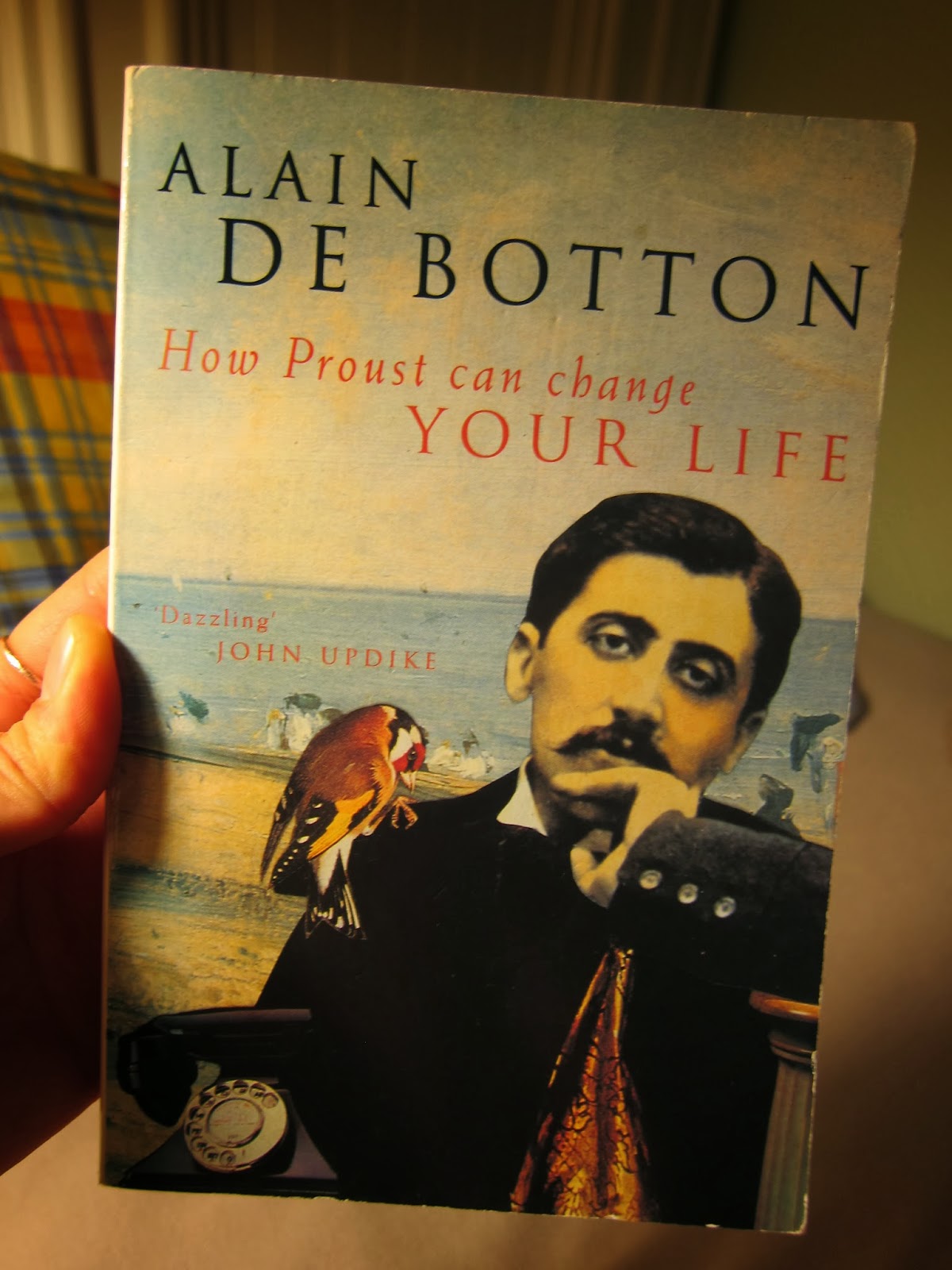
How Proust Can Change Your Life --Alain de Botton
My legs were uncomfortabl(ly warm)e so I slipped them out from under the covers.
Then my teeth were uncomfortabl(ly tight)e in their retainers so those got slipped out, too.
Then my teeth were uncomfortabl(ly tight)e in their retainers so those got slipped out, too.
 |
| the following quotations are from here (what the...there are youtube renditions of this) |
How to Put Books Down:
"...we should be reading for a particular reason: not to pass the time, not out of detached curiosity, but out of a dispassionate wish to find out what Ruskin felt, but because, to repeat with italics, "there is no better way of coming to be aware of what one feels oneself than by trying to recreate in oneself what a master has felt." We should read other people's books in order to learn what we feel; it is our own thoughts we should be developing even if it is another writer's thoughts that help us do so. A fulfilled academic life would therefore require us to judge that the writers we were studying articulated in their books a sufficient range of our own concerns, and that in the act of understanding them through translation or commentary, we would simultaneously be understanding and developing the spiritually significant parts of ourselves.
And therein lay Proust's problem, because in his view, books could not make us aware of enough of the things we felt. They might open our eyes, sensitize us, enhance our powers of perception, but at a certain point they would stop, not by coincidence, not occasionally, not out of bad luck, but inevitably, by definition, for the stark and simple reason that the author wasn't us. There would come a moment with every book when we would feel that something was incongruous, misunderstood, or constraining, and it would give us a responsibility to leave our guide behind and continue our thoughts alone...
It is one of the great and wonderful characteristics of good books (which allow us to see the role at once essential yet limited that reading may play in our spiritual lives) that for the author they may be called "Conclusions" but for the reader "Incitements." We feel very strongly that our own wisdom begins where that of the author leaves off, and we would like him to provide us with answers when all he is able o do is provide us with desires... That is the value of reading, and also its inadequacy. To make it into a discipline is to give too large a role to what is only an incitement. Reading is on the threshold of the spiritual life; it can introduce us to it: it does not constitute it.
It obliges us to read with care, to welcome the insights books give us, but not to subjugate our independence or smother the nuances of our own love life in the process.
Otherwise, we might suffer a range of symptoms that Proust identified in the overreverent, overreliant reader:
.........
Symptom No. 2: That we are unable to write after reading a good book:
Reading Proust nearly silenced Virginia Woolf... "Proust so titillates my own desire for expression that I can hardly set out the sentence. Oh if I could write like that! I cry. And at the moment such is the astonishing vibration and saturation that he procures -- there's something sexual in it -- that I feel I can write like that, and seize my pen and then I can't write like that."
"I detest my own volubility. Why be always spouting words?"
"This is the worst time of all. It makes me suicidal. Nothing seems left to do. All seems insipid and worthless."
"[In Search of Lost Time] which is of course so magnificent that I can't write myself within its arc. For years I've put off finishing it; but now, thinking I may die one of these years, I've returned, and let my own scribble do what it likes. Lord what a hopeless bad book mine will be!"
The tone suggests that Woolf had at last made her peace with Proust. He could have his terrain, she had hers to scribble in. The path from depression and self-loathing to cheerful defiance suggested a gradual recognition that one person's achievements did not have to invalidate another's, that there would always be something left to do even if it momentarily appeared otherwise. Proust might have expressed many things well, but independent thought and the history of the novel had not come to a half with him. His book did not have to be followed by silence; there was still space for the scribbling of others, for Mrs. Dalloway, The Common Reader, A Room of One's Own, and in particular, there was space for what these books symbolized in this context -- perceptions of one's own."
--------------------------------the application:------------------------------
These are layers and layers of genius to grapple with, learn from, and irreverently throw aside after having ingested their healthy juices. As healthy and addictively refreshing as regular bowel movements, a happy colon with a diet full of fiber.
I feel like I am learning how to read from this book. The best kinds of teachers are the ones you can leave behind, aren't they? No matter how good their handwriting, no matter how ingenious their analysis of To the Lighthouse, no matter how inferior you feel in their presence -- actually, the best, the most effective, the most truly inspirational of all teacherly beings are the ones who allow you to stand on their shoulders and look into worlds beyond their own scope. Teachers with teachings that are great enough to cause those heart tremors, but humble enough to allow for the possibility of greater, fiercer vibrations.
Those who equip us with the real tools, of believing in the distinct realizability of our loftiest dreams. In made-up words and over-hyphenization, allll included.
 |
| "Lord what a helpless bad book mine will be!" |
There
are unbreathed, disquieted rumblings on the insides of my insides. I can't wait to read A la recherche de temps perdu. I can't wait to finish it and to put it down and then to poop out my own poop (...sorry; stop thinking about it...now!). But for now, it's legs-under-the-covers and retainers, back on: getting prepared for the good work of tomorrow and tomorrow's tomorrow's tomorrows.
Tuesday, October 8, 2013
Thank you, God, for Gothic Literature
How do you navigate through life's struggles?
How do you pick your mate?
What is good? What is evil? What are we?
How do you deal with displacement and abandonment and that foreverlonely you feel in the pit of your stomach, no matter how much you try to squash it down with loud noises and bright lights and even seemingly-worthy Pursuits of Happiness?
"Literature answers philosophical questions with particulars. Novels throw a bunch of people together on a level playing field and have them work out these human problems."
And we watch and learn, laughing and crying and frowning in vicarious pain and joy and ah-hah moments.
That's why people believe in life-saving poetry and stuff. It's how terrible circumstances are redeemed as tools for recovery and encouragement; like how phoenixes rise from their own ashes and how beautiful flowers grow from poop.
Good words to think about on a melancholy Monday afternoon of a fourth-year fall semester.
Thank you, God, for literature.
Thank you, God, for this undergraduate path as an English major.
Thank you, God, for Mysteries of Udolpho and the weepy sensibilities of Emily St. Aubert and for saving us poor unfortunate souls from ourselves.
 |
| for a lucky few, life is not so struggley. though maybe that's an unfair judgment from a haughty perspective. |
Thursday, August 22, 2013
seemingly depressing things, franklys, and tattery endings
Is the best good you can do, ultimately, resignation to mediocrity?
^That seemingly depressing opening sentence was supposed to be the depressing opening to a thoroughly depressing post, and as it was being mentally laid out in the cloudy loops of my brain during the conversation that inspired it, had all the intention of being so. Exactly so.
I'm quietly proud of my parents - humbled, thankful, and awed, often, by my good relationship with them together and him and her as individuals. Though certainly not with everything, my dad is remarkably patient with us. It's admirable and impressive, how determinedly he holds onto his mind and cool as we play the appropriately immature parts of the stubborn little babies we are. Stubborn little babies who got progressively worse and worse at math as the classes changed from Algebra to Trig to Calculus, too, and math was really the least of his troubles with us. It's a terrible thing to abuse, this patience, but no matter how many times we turn our gaping mouths in that unsightly "...huh?" toward him, my dad can erase all the previously explained and start over. And over. And over.
My mom is a little less adept with the stuff regarding repetition - strict no-more-than-three-reps policy here, or you'll pay the price by listening to a(n ironically) repetitive lecture about how You Never Listen for anywhere from 30 minutes to 3 weeks - but her virtues shine through her actions. She's the most compassionate, and untiringly-, uncomplainingly-hardworking person I know. Sometimes when she shares tidbits of her life philosophy with me, it's in the form of offhand slips of verbal gems she just casually and spontaneously tosses about, like dustbunnies that get unearthed in search of something else in the attic-resident trunk. Makes them seem a lot less monumental than they are truly worth, so I sort of have to rub my eyes and stay alert when she does this, and pick up those pieces and tuck them away for further study later, quietly in my room or something.
The two plump paragraphs above deserve [much more than] a whole post of their own, really, but for today, they're just gonna serve as disproportionately-lengthy prefaces to the sentence that shall follow:
Today's, in particular, was disheartening to the point of embarrassed tears. To the point of one whole sigh-filled afternoon, leaving behind its funk long after the actual conversation was over. To the point of that seemingly depressing opening sentence up^ there.
And today's, anyways, was different, too - advice against "all these documentaries I've been watching recently" and inappropriate allusions to the French Resistance movement during WWII all tossed in there like a bowl of discordant fruit salad. Like, with cabbage and mangoes trying to make it jive. All confusion about history and fruits aside, in essence, this is what they told me.
They told me to go with the flow. To just be aregularhumdrum person, with a regularhumdrum job. That things don't change. That I am such a small part of the equation, that power is so corrupting, that these social problems are inevitable. And pervasive. And so there. Just live your own life, resign yourself to mediocrity, and try not to get crushed by the forces out there, little one, cause going against the grain of society is a hard, hard thing. And please just get a stable job in a big corporation.
Yup, I am often bitter when I think of hypothetical Other Parents who support their children unconditionally, in anything and everything they are passionate about - especially when object of those passions seem so socially responsible and selflessly beneficial to the world and hopeful and good and objectively easy to root for. [Aside: Parenting, of all styles, must be so hard. It's terrifying. I think well-considered decisions to have children are some of the greatest acts of faith and hope we humans commit.]
But it must be a small sign of growing up that I didn't just shut down at that point in the conversation, cause I dunno - some short amount of time ago, I wouldn't have even stayed at the table for that to get finished. I mean what travesty, right? How could you be so unsupportive and doubtful of what I change I can effect in the world?! You two are the worst stomp stomp stomp etc. I am young and un-trodden upon by society, YOU JERKS, stop trying to nip my potential in the BUD stomp. Let me burn dat ephemeral flame of YOUTH, DANG IT. And why am I so afraid to mention the God aspect of all this to them?
Thank goodness I didn't stomp on out of there like that. Cause the rest of this talk was indeed a healthy reminder of the fact that I am so undeniably a Romantic-Realist, and of my need for equal doses of both sides of that hyphen. That yeah - at least evidenced by the second half of that indecisive self-given identity-label, I am such a child of my parents.
They told me that it's important to be wary of the depressing, deflating effects of those social problems I feel so righteously angered and upset by. That anger - no matter how justified or righteous - is often counterproductive and always energy-inefficient. To remember the beautiful things. To be recharged by beauty and good, to maintain that balance within myself, cause frankly, the world is unbearable without that. It was a gentle, a revolutionary, reminder that I'm allowed to be personally happy in the midst of all this depressing stuff. That it actually helps, in a lot of subtle ways.
And though ultimately, we're still in clear disagreement about what we believe needs to be done - and possibly can be hoped to be done - about the sorry state of this world, and specifically, what I can do about it all (and more specifically...after that graduating business), they. are. right. Absolutely. My specific anger, at least at this particularly powerless point in my life and from this particularly influence-less place in society, burns furiously only against myself. If I don't keep this vague bitterness-against-all-the-ugly-stuff checked and specific and well-informed and most importantly, balanced with generous doses of Good and Beauty in the world, it will probably accomplish very little other than destroy my tiny life. Which, ultimately, is just accomplishing very little. I'm nothing to make a martyr out of. Not yet, anyways. I mean society's just getting finished educating me - and I still have a whole year to go. My time to give back is juuust peeping around the corner. Shy or something.
In more ways than this, so many, it is good to listen to my parents' [basically opposite-from-mine-] opinions and advice. If the fact that they've experienced me (in addition to their own lives, own societal problems, own political frustrations) through my terrible two's and awkward teenage years and all the jazz in between and really, to their fullest human knowledge and ability, want what they believe is the best for me isn't enough, then for the cool and reasoned answer that opposition is healthy in appropriate amounts. It critiques and challenges and sharpens and fosters a better-rounded growth.
Cause everything seemingly depressing, including mediocrity, is sort of a two-sided beast with its very own upside - just as anything seemingly good isn't ever completely, unconditionally Good. Simply put, the world is complicated, and the only control you have over its confusion is your reaction to it all. So I'm thinking, maybe I should alternate these documentary consumptions with Disney movies or something. Not that Disney movies necessarily deserve the label of capital-g Good, but frankly, neither do documentaries. And because, frankly, that's just the first thing that popped into my head and because, frankly, it's fine to not end on a warm, fuzzy note of enlightenment and conclusiveness. Sometimes it's just marking the progress of things, and that's that.
^That seemingly depressing opening sentence was supposed to be the depressing opening to a thoroughly depressing post, and as it was being mentally laid out in the cloudy loops of my brain during the conversation that inspired it, had all the intention of being so. Exactly so.
I'm quietly proud of my parents - humbled, thankful, and awed, often, by my good relationship with them together and him and her as individuals. Though certainly not with everything, my dad is remarkably patient with us. It's admirable and impressive, how determinedly he holds onto his mind and cool as we play the appropriately immature parts of the stubborn little babies we are. Stubborn little babies who got progressively worse and worse at math as the classes changed from Algebra to Trig to Calculus, too, and math was really the least of his troubles with us. It's a terrible thing to abuse, this patience, but no matter how many times we turn our gaping mouths in that unsightly "...huh?" toward him, my dad can erase all the previously explained and start over. And over. And over.
My mom is a little less adept with the stuff regarding repetition - strict no-more-than-three-reps policy here, or you'll pay the price by listening to a(n ironically) repetitive lecture about how You Never Listen for anywhere from 30 minutes to 3 weeks - but her virtues shine through her actions. She's the most compassionate, and untiringly-, uncomplainingly-hardworking person I know. Sometimes when she shares tidbits of her life philosophy with me, it's in the form of offhand slips of verbal gems she just casually and spontaneously tosses about, like dustbunnies that get unearthed in search of something else in the attic-resident trunk. Makes them seem a lot less monumental than they are truly worth, so I sort of have to rub my eyes and stay alert when she does this, and pick up those pieces and tuck them away for further study later, quietly in my room or something.
The two plump paragraphs above deserve [much more than] a whole post of their own, really, but for today, they're just gonna serve as disproportionately-lengthy prefaces to the sentence that shall follow:
I can't really and completely share with them about my vision for the future."Vision" being that mystical, vague haze also known as Postgrad Life Plans, and future being that equally unclear patch of mystery time that begins After May. My soon-to-come first-ever institutional void, all of which, thanks to the combination of ~40% my own lack of direction and ~60% lack of desire to communicate with my parents about it, isn't really a subject we have much to discuss about anyways. And which, I know, is a validly-timed and validly-directed sort of discussion for us to be having right about now... But the trouble is that I feel so fundamentally different about what I think I want for my future than they think they do that it's just defeating and deflating to even begin the conversation. A former nurse and current engineer - practical and sensible and realistic as their jobs - talking to an English major - and general Poster Child-result of the blessings and woes of a liberal arts education - who says she doesn't want to teach or go into academia. Yeah cue those womps. Three of them.
Today's, in particular, was disheartening to the point of embarrassed tears. To the point of one whole sigh-filled afternoon, leaving behind its funk long after the actual conversation was over. To the point of that seemingly depressing opening sentence up^ there.
And today's, anyways, was different, too - advice against "all these documentaries I've been watching recently" and inappropriate allusions to the French Resistance movement during WWII all tossed in there like a bowl of discordant fruit salad. Like, with cabbage and mangoes trying to make it jive. All confusion about history and fruits aside, in essence, this is what they told me.
They told me to go with the flow. To just be a
Yup, I am often bitter when I think of hypothetical Other Parents who support their children unconditionally, in anything and everything they are passionate about - especially when object of those passions seem so socially responsible and selflessly beneficial to the world and hopeful and good and objectively easy to root for. [Aside: Parenting, of all styles, must be so hard. It's terrifying. I think well-considered decisions to have children are some of the greatest acts of faith and hope we humans commit.]
But it must be a small sign of growing up that I didn't just shut down at that point in the conversation, cause I dunno - some short amount of time ago, I wouldn't have even stayed at the table for that to get finished. I mean what travesty, right? How could you be so unsupportive and doubtful of what I change I can effect in the world?! You two are the worst stomp stomp stomp etc. I am young and un-trodden upon by society, YOU JERKS, stop trying to nip my potential in the BUD stomp. Let me burn dat ephemeral flame of YOUTH, DANG IT. And why am I so afraid to mention the God aspect of all this to them?
Thank goodness I didn't stomp on out of there like that. Cause the rest of this talk was indeed a healthy reminder of the fact that I am so undeniably a Romantic-Realist, and of my need for equal doses of both sides of that hyphen. That yeah - at least evidenced by the second half of that indecisive self-given identity-label, I am such a child of my parents.
They told me that it's important to be wary of the depressing, deflating effects of those social problems I feel so righteously angered and upset by. That anger - no matter how justified or righteous - is often counterproductive and always energy-inefficient. To remember the beautiful things. To be recharged by beauty and good, to maintain that balance within myself, cause frankly, the world is unbearable without that. It was a gentle, a revolutionary, reminder that I'm allowed to be personally happy in the midst of all this depressing stuff. That it actually helps, in a lot of subtle ways.
And though ultimately, we're still in clear disagreement about what we believe needs to be done - and possibly can be hoped to be done - about the sorry state of this world, and specifically, what I can do about it all (and more specifically...after that graduating business), they. are. right. Absolutely. My specific anger, at least at this particularly powerless point in my life and from this particularly influence-less place in society, burns furiously only against myself. If I don't keep this vague bitterness-against-all-the-ugly-stuff checked and specific and well-informed and most importantly, balanced with generous doses of Good and Beauty in the world, it will probably accomplish very little other than destroy my tiny life. Which, ultimately, is just accomplishing very little. I'm nothing to make a martyr out of. Not yet, anyways. I mean society's just getting finished educating me - and I still have a whole year to go. My time to give back is juuust peeping around the corner. Shy or something.
In more ways than this, so many, it is good to listen to my parents' [basically opposite-from-mine-] opinions and advice. If the fact that they've experienced me (in addition to their own lives, own societal problems, own political frustrations) through my terrible two's and awkward teenage years and all the jazz in between and really, to their fullest human knowledge and ability, want what they believe is the best for me isn't enough, then for the cool and reasoned answer that opposition is healthy in appropriate amounts. It critiques and challenges and sharpens and fosters a better-rounded growth.
Cause everything seemingly depressing, including mediocrity, is sort of a two-sided beast with its very own upside - just as anything seemingly good isn't ever completely, unconditionally Good. Simply put, the world is complicated, and the only control you have over its confusion is your reaction to it all. So I'm thinking, maybe I should alternate these documentary consumptions with Disney movies or something. Not that Disney movies necessarily deserve the label of capital-g Good, but frankly, neither do documentaries. And because, frankly, that's just the first thing that popped into my head and because, frankly, it's fine to not end on a warm, fuzzy note of enlightenment and conclusiveness. Sometimes it's just marking the progress of things, and that's that.
Saturday, December 31, 2011
headline bossy clichés of 2011
Do not despair.
Find a balance.
Journal always.
Take deep breaths and
Stap ze inzecurity.
Love more.
Keep learning.
Stop being so bossy.
Farewell 2011 & Hello 2012 in eight deep breaths!
Wednesday, November 30, 2011
wednesday convictions
To not only read great literature as a "break from other homework"
To not only read great literature and only be "struck by it" "moved by it" even to tears or heart-clutching gasp-y-ness
To not only read great literature and tuck it away on an "I Own These" shelf
To not only read great literature and tuck it away in my pocket, in my little world, just as a part of this "grape semester"
But to pull it out every day and
To use it
- To love,
- To be kind,
- To overcome my own me-ness,
As a tool God gives me
To change the world.
Subscribe to:
Posts (Atom)