Showing posts with label art. Show all posts

Wednesday, April 2, 2014

call and response

My attempts at writing are really agonizing...
I am in the lowest possible spirits. I have been telling myself I am neither a painter nor a writer, I am not even a decent teacher. It seems to me I have been swindling the world by some sort of flash or glitter when there is nothing inside me. I tried to renounce creativity and live like an average person, but this feels very sad.
B Schulz (15 November 1936, Letters, 140) 
Today, I can say that Schulz's writing showed me a way to write about the Shoah, and, in a sense, also a way to live after the Shoah. Sometimes there are such moments of grace: you open a book by an author you don't know, and suddenly you feel yourself passing through a magnetic field that sends you in a new direction, setting off eddies that you'd barely sensed before and could not name. I read Schulz's stories and felt the gush of life. On every page, life was raging, exploding with vitality, suddenly worthy of consciousness and subconsciousness, in dreams, in illusions, and in nightmares. I felt the stories' ability to revive me, to carry me beyond the paralysis and despair that inevitably gripped me whenever I thought about the Holocaust or came into contact with the aspects of human nature which had ultimately allowed it to happen.
David Grossman, The Age of Genius 

Tuesday, April 1, 2014

[thəp]/dear first year ladison

what is the definition of art?
must it serve a purpose?
how do you define that purpose? (can art be an end in itself? can beauty? can pleasure?)
what about goodness?
what if the purpose is evil, but it's really beautiful, but it's really evil [masochistic beauty? thorny rose?]

There are (still) many things that make me feel like a nobody, a noob. It's hard to strike the perfect balance, and trying to tackle a problem by formulating the hypothesis with the word "perfect" in it probably doesn't help.

But hey, freshest source of conflict: art & utility.

I've been learning a lot about the value of [utility], as counter-posed against [art]. Yes, blah blah art is purposeful; sometimes art is all we can do to render meaning and beauty; are you saying you are a utilitarian blah blah STOP. I know it's a crude and contentious distinction, but simmer down, self, cause I'm just trying to figure things out, like most of the rest of the time(s).

So I've been learning, taking in, feeling, thinking about this art-utility thing, and mostly, it's illumination upon all the things I am clearly not illuminated about - which makes me feel hopeful that I'm at least facing the right direction. As a fourth year English major, having to read and write and say a lot of words in general, I'm realizing that a lot of my time these two semester is being taken up in the Defense of Myself/My Major/My Murky Vocational Future. And I get this. It doesn't even annoy me anymore.

Because I think I'm learning, taking in, feeling, thinking, that technical and hard-sciences knowledge is actually really appealing to me, sometimes embarrassingly so, as I flounder about in my non-knowledge and blind admiration of random Bio majors and pre-health people who seem to be doing things with their lives, but still realize that the world is utterly incomplete without its random beauty and seemingly coincidental creation of things and other Things That Seem to Have No Clear Purpose.

There is indeed a place and a time for every little thing, is gonna be allriiight.

Man. The more I learn, the less I seem to know.
So, eh-hem, dear postgrad Ladison, remember these things and try to blabber less foolishly.

Thursday, March 20, 2014

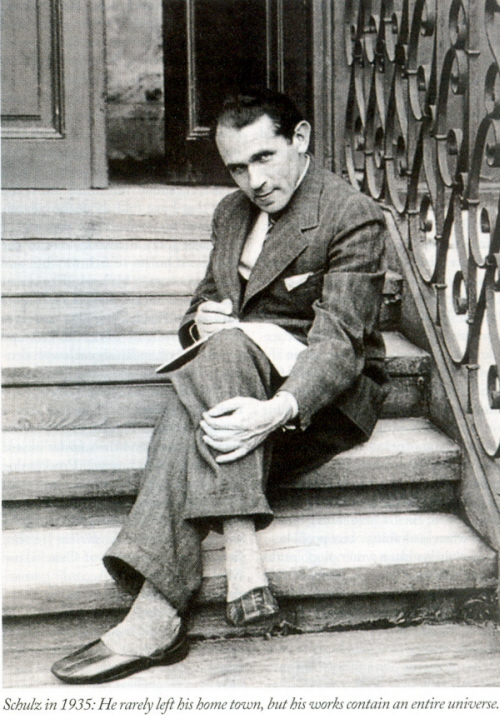
SCHULZ on ART

I do not know just how in childhood we arrive at certain images, images of crucial significance to us. They are like filaments in a solution around which the sense of the world crystallizes for us... They are meanings that seem predestined for us, ready and waiting at the very entrance of our life...
These early images mark the boundaries of an artist's creativity. His creativity is a deduction from assumptions already made. He cannot now discover anything new; he learns only to understand more and more the secret entrusted to him at the beginning, and his art is a constant exegesis, a commentary on that single verse that was assign him. But art will never unravel that secret completely. The secret remains insoluble. The knot in which the soul was bound is no trick knot, coming apart with a tug at its end. On the contrary, it grows tighter and tighter. We work at it, untying, tracing the path of the string, seeking the end, and out of this manipulating comes art...

Tuesday, January 28, 2014

TRANSDUCTION


It Is Enough

by Anne Alexander Bingham
To know that the atoms
of my body
will remain

to think of them rising
through the roots of a great oak
to live in
leaves, branches, twigs

perhaps to feed the
crimson peony
the blue iris
the broccoli

or rest on water
freeze and thaw
with the seasons

some atoms might become a
bit of fluff on the wing
of a chickadee
to feel the breeze
know the support of air

and some might drift
up and up into space
star dust returning from

whence it came
it is enough to know that
as long as there is a universe
I am a part of it.


Friday, January 10, 2014

How Proust Can Change Your Life --Alain de Botton

My legs were uncomfortabl(ly warm)e so I slipped them out from under the covers.
Then my teeth were uncomfortabl(ly tight)e in their retainers so those got slipped out, too.
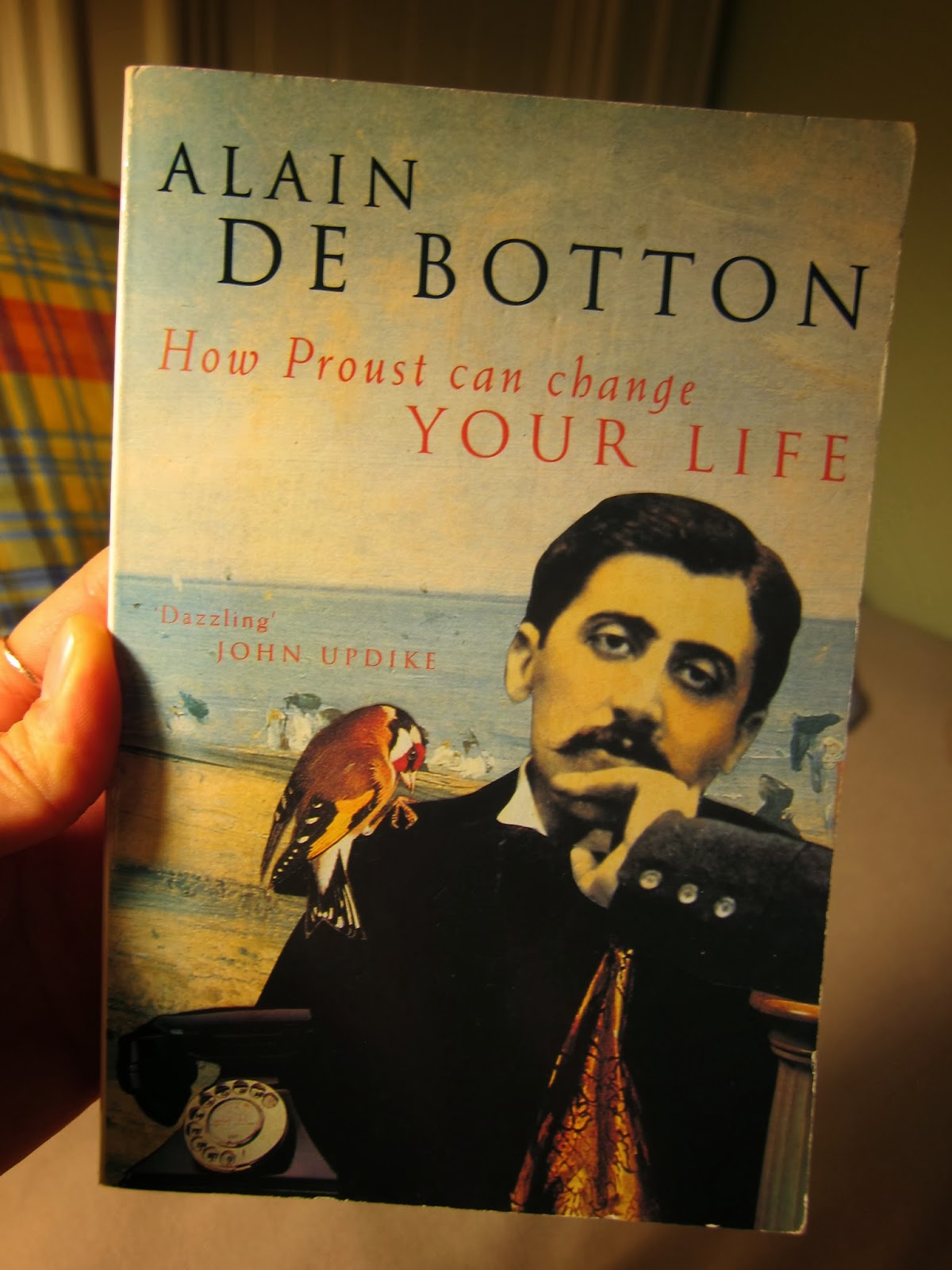
the following quotations are from here
(what the...there are youtube renditions of this)

How to Put Books Down:
"...we should be reading for a particular reason: not to pass the time, not out of detached curiosity, but out of a dispassionate wish to find out what Ruskin felt, but because, to repeat with italics, "there is no better way of coming to be aware of what one feels oneself than by trying to recreate in oneself what a master has felt." We should read other people's books in order to learn what we feel; it is our own thoughts we should be developing even if it is another writer's thoughts that help us do so. A fulfilled academic life would therefore require us to judge that the writers we were studying articulated in their books a sufficient range of our own concerns, and that in the act of understanding them through translation or commentary, we would simultaneously be understanding and developing the spiritually significant parts of ourselves.

And therein lay Proust's problem, because in his view, books could not make us aware of enough of the things we felt. They might open our eyes, sensitize us, enhance our powers of perception, but at a certain point they would stop, not by coincidence, not occasionally, not out of bad luck, but inevitably, by definition, for the stark and simple reason that the author wasn't us. There would come a moment with every book when we would feel that something was incongruous, misunderstood, or constraining, and it would give us a responsibility to leave our guide behind and continue our thoughts alone...

It is one of the great and wonderful characteristics of good books (which allow us to see the role at once essential yet limited that reading may play in our spiritual lives) that for the author they may be called "Conclusions" but for the reader "Incitements." We feel very strongly that our own wisdom begins where that of the author leaves off, and we would like him to provide us with answers when all he is able o do is provide us with desires... That is the value of reading, and also its inadequacy. To make it into a discipline is to give too large a role to what is only an incitement. Reading is on the threshold of the spiritual life; it can introduce us to it: it does not constitute it. 

It obliges us to read with care, to welcome the insights books give us, but not to subjugate our independence or smother the nuances of our own love life in the process.

Otherwise, we might suffer a range of symptoms that Proust identified in the overreverent, overreliant reader:

.........

Symptom No. 2: That we are unable to write after reading a good book:
Reading Proust nearly silenced Virginia Woolf... "Proust so titillates my own desire for expression that I can hardly set out the sentence. Oh if I could write like that! I cry. And at the moment such is the astonishing vibration and saturation that he procures -- there's something sexual in it -- that I feel I can write like that, and seize my pen and then I can't write like that." 

"I detest my own volubility. Why be always spouting words?"

"This is the worst time of all. It makes me suicidal. Nothing seems left to do. All seems insipid and worthless."

"[In Search of Lost Time] which is of course so magnificent that I can't write myself within its arc. For years I've put off finishing it; but now, thinking I may die one of these years, I've returned, and let my own scribble do what it likes. Lord what a hopeless bad book mine will be!"

The tone suggests that Woolf had at last made her peace with Proust. He could have his terrain, she had hers to scribble in. The path from depression and self-loathing to cheerful defiance suggested a gradual recognition that one person's achievements did not have to invalidate another's, that there would always be something left to do even if it momentarily appeared otherwise. Proust might have expressed many things well, but independent thought and the history of the novel had not come to a half with him. His book did not have to be followed by silence; there was still space for the scribbling of others, for Mrs. Dalloway, The Common Reader, A Room of One's Own, and in particular, there was space for what these books symbolized in this context -- perceptions of one's own."


--------------------------------the application:------------------------------


These are layers and layers of genius to grapple with, learn from, and irreverently throw aside after having ingested their healthy juices. As healthy and addictively refreshing as regular bowel movements, a happy colon with a diet full of fiber. 

I feel like I am learning how to read from this book. The best kinds of teachers are the ones you can leave behind, aren't they? No matter how good their handwriting, no matter how ingenious their analysis of To the Lighthouse, no matter how inferior you feel in their presence -- actually, the best, the most effective, the most truly inspirational of all teacherly beings are the ones who allow you to stand on their shoulders and look into worlds beyond their own scope. Teachers with teachings that are great enough to cause those heart tremors, but humble enough to allow for the possibility of greater, fiercer vibrations. 

Those who equip us with the real tools, of believing in the distinct realizability of our loftiest dreams. In made-up words and over-hyphenization, allll included. 

"Lord what a helpless bad book mine will be!"

There 
are unbreathed, disquieted rumblings on the insides of my insides. I can't wait to read A la recherche de temps perdu. I can't wait to finish it and to put it down and then to poop out my own poop (...sorry; stop thinking about it...now!). But for now, it's legs-under-the-covers and retainers, back on: getting prepared for the good work of tomorrow and tomorrow's tomorrow's tomorrows.
Thursday, March 24, 2011

art, art, i want you; art, you make it pretty hard not to

First, click the play button on the video below and listen while you read. Then after you're done reading, listen to the words again carefully. Sorry if you feel bossed around - you don't have to if you don't want to heeheee

There are many things that make me feel like a nobody, a noob. n00b. Taking the bus. Crossing unfamiliar crosswalks. Talking about nice and not so nice cars. But most of the time when that happens, it's okay. I actually kind of like feeling small - like I'm just a teeny piece of something bigger, something greater and more purposeful, like yeah I don't understand what's right in front of me but zoom out and you'll see a more coherent, make-sensical picture and ultimately everything really does make sense, at some level - that's nice. And it's good to be honest about one's noobishness and unashamedly so, sometimes (um yeah I'm having a little trouble figuring out which way to go in this FOUR-WAY crosswalk, but hey it's like only my 4th time here and there are so many cars and persons all around and this thang is complicated!), cause it makes for a good learning experience.

But the thing is, sometimes I feel like a noob about things I claim to love - things I know I do love. Things people think I'm good at (eeeeeep!), just by virtue my appreciation of them, combined with the semi-obscurity of said topics. Poetry. Art. Conversationing about human hearts. Blabbering words and sentences and not being sure I make sense, and even worse, experiencing someone else's elegant eloquence - extremely excellent - and being dwarfed by their genius. Don't misunderstand me - it's not about being jealous or bitter that I'm not smart enough. It's more like...being reminded about how much genius is truly out there in the big world, outside of my own head and feeling kind of scared because I'm supposed to "be good at this," cause supposedly, "omg I luff poetry!" you know? But do I dare even utter these things? Do I dare declare myself an English major? Who will care about what I say, do, make, write, synthesize, create? Am I even worthy of claiming that I love these things, when I know so little and am so inept at even expressing my love? I have no idea.

Art

For those of you who will not click the play button above:

"Art, art, I want you. Art, you make it pretty hard not to.
And my heart is trying hard, here, to follow you
but I can't always tell if I ought to."