Showing posts with label humanities. Show all posts

Thursday, March 13, 2014

"oy vey"s & in-advance hallelujahs

“The case for the humanities is not hard to make, though it can be difficult--to such an extent have we been marginalized, so long have we acceded to that marginalization--not to sound either defensive or naive. The humanities, done right, are the crucible within which our evolving notions of what it means to be fully human are put to the test; they teach us, incrementally, endlessly, not what to do but how to be. Their method is confrontational, their domain unlimited, their "product" not truth but the reasoned search for truth, their "success" something very much like Frost's momentary stay against confusion.”
― Mark Slouka

This year, for the first time in at least a very long time (perhaps since the beginning of things), the English department's graduation ceremony will not be held on the Lawn. It's historic and subtle at the same time, significant and sort of sneaky, because they're just shifting us over to the amphitheater - arguably just as central to the university grounds and just as appropriate for the values of the English major. "We deal with theater, too," my Jewish lit professor said, a little dejectedly.

I guess... But let's be real. She was just as unconvinced as I am about the okayness of this whole Lawn --> Amphitheater shift. It's not the same.

The sand dunes of education have been changing, bit by bit, one wind drift after another, displacing mountains of sand and creating brand new ones elsewhere, subtly but certainly changing the landscape of the humanities. It's hugely symbolic, this change, and merely symptomatic of the undercurrents of change rushing beneath the surface. We've forgotten how to value the humanities. What about the renaissance man ideal? What about the Grand Tour? I feel like I was born in the wrong century. But if that could somehow be rectified, I would be the wrong gender. Oy vey.

It's disturbing, but maybe that's only because I happen to be on this side of the demarcation. The "wrong side," outdated and marginalized because those are the rules of society today, just as the merchants and craftsmen must have felt in the days of those bougie renaissance men who got to travel all over Europe in their privileged, bougie, fancypantsy lives. And it would be too blindly simplistic to just stomp my left foot in indignation at the loss of humanity!!!!!1 and the deplorable values!!! of our society, because you've gotta give credit to those responsible, productive-members-of-society-to-be for wanting to make themselves marketable. To become employed someday and earn the moneys. To provide for their future families and their future families.

They might even be closet poetry lovers; martyrs, in a sense, led to the sacrificial pyre of our failing economy, burning bright with the irresistible aura of Wall Street, beckoning us like helpless moths toward those cruel but effective zappy summer camp lights, and the grinding machinations of our Society of Productivity. It's all complicated.

All I know is that the Comm school has the plushiest of chairs, and I did not choose to study anything remotely related to money and other potentially depressing things.

But still, while I mourn for the loss of the English department's fight for the Lawn during that epic ceremony of the class of 2014, I am also at peace. Our growing obsession with money wasn't anything unanticipated by Jesus. Just google yourself a favor and ask the internet: "how many verses about money in the bible." We are so predictable, and that's weirdly reassuring.

This probably explains why I am more excited than scared for that insane, forever-anticipated May date when my formal education officially ends (for now), and life as I know it will veer crazily off its track of predictable year-after-years of being a ____-grader. I will no longer be defined by the number of years I've been in school, and hopefully also by other numbers, too, though I hear that's a little more persistent of a problem (SAT scores... GPA... GREs... salary... the numbers don't end).

As of now, March 13th 2014, life after May something 2014 is a void, in many senses - I will no longer have that "occupation" as Full-Time Student, will no longer be "going to UVA," will no longer "be" an English major; all these things will have been relegated to past-tense realities. But at the same time, many things continue: ever a follower of Christ, a child of God, a daughter to my parents and sister to my sister, there are lots of things to find my identity in.

So in this moment, I take delight in the adventuresome excitement of the blankness. "That's pretty hard, being excited about uncertainty," someone said to me a little while back, when I was gushing (not rully) about the exciting combination of not having a job + graduating in a few months. But I dunno -- I am okay. I'm doing okay. Praise God for that, because even this momentary sanity is because of the fact that in him all things hold together. Every second of normalcy and sanity is a paradox and a miracle.

As will be the moment when I do finally get a job or something. Miracle indeed. In-advance Hallelujahs abound.

Tuesday, March 4, 2014

Thank you God for Emergencies in PAVS 4500

and again

The power of fiction is to create empathy. It lifts you away from your chair and stuffs you gently down inside someone else's point of view... A newspaper could tell you that one hundred people, say, in an airplane, or in Israel, or in Iraq, have died today. And you can think to yourself, "How very sad," then turn the page and see how the Wildcats fared. But a novel could take just one of those hundred lives and show you exactly how it felt to be that person rising from bed in the morning, watching the desert light on the tile of her doorway and on the curve of her daughter's cheek. You could taste that person's breakfast, and love her family, and sort through her worries as your own, and know that a death in that household will be the end of the only life that someone will ever have. As important as yours. As important as mine.

from "High Tide in Tucson" -Barbara Kingsolver

Friday, February 28, 2014

growing up &whatevers

I wonder if "growing up" simply means growing more and more "human" as we proceed through more and more of life, like becoming bigger- and bigger-hearted into the beings we were made to be.  Each life decision widens us; each big event expands our capacity to feel and then to empathize.  The highs and the lows are higher and lower as we grow older and more profound in our thinkings, feelings, the scope of our sandboxes.

Once you have fallen head over heels in infatuation, once your heart has been (seemingly) irreparably shattered, once you become responsible for a little life and a little soul whose growing-up you're put in charge of for a short little while, you get to tuck away each of those experiences into its right corner in your now-expanded heart, in spaces that hadn't existed before because there was nothing for them to hold.

You go through a shattering experience; it makes you feel more terrible than anything you had ever imagined even possible, and that's just fine because it's exactly right, how confusingly new this feels. That's how that new hurt is supposed to sting; those neurons just hadn't been fired ever before.  And through all of this, your spectrum of brokenness grows wider, and as does your spectrum of empathy.  Same with love.  And becoming a mom or a dad.  And your first-ever bite of chocolate, probably.  How could you rave about the wonders of the cacao bean without having tasted a sliver of its sugar-powered magic?

Makes tragedies seem that much less intimidating, that much more purposeful.  Makes future joys that much more exciting to look forward to.

But the key here is that you have to have those [shattering/falling/heart-expandingly delicious] experiences first, and suffer appropriate[ly beautiful/tragic] consequences for those choices.  To have courage to reach out and touch things previously unseen, to declare unabashedly that you are of This Camp or That, to decide to let go or hold on, whichever is scarier.

Someone described the concept of predestination to me by explaining that "you're chosen by God (like, since the beginning of eternity) once God chooses you." It sounds circular and probably makes philosophers jump up and down in illogical rage, but this weirdly makes sense to me; like in a this is sort of the only way it would make sense way.  Like how you have to reach out to touch someone who is reaching out to you for there to be a real connection, a genuine falling in love, but you know you were supposed to be together since the beginning of the stars or whatever.

Or whatever.

Stars or eternities or predestined love stories since the beginning of all galaxies, or whatever.

Why does everything always end up being about love?  Ohhhh English major.

Wednesday, February 12, 2014

what is an English major

What's in a name? that which we call a rose 
By any other name would smell as sweet.

some more ideas:


There's love and computers and good old reading, writing, thinking,
Soulstuff.
Lines and connections and disparate things coming poetically (or not) together.

And people, too, trying to figure all of it out.

Kinda like life.

Wednesday, January 15, 2014

"ten years from now, I am happy"

Ten years from now, I am happy.
Ten years from now, I am twent thirty-two, and married to a person I call "home." 
Not literally his nickname, unless...this becomes an inside joke. With "home" (uh-oh) we make a pair that needs no home other than (mostly) ourselves, living in places that were always recently "far-off lands," and reveling (and reeling) in all the mysteries and adventure (and difficulties) that come with that. Togetherly.
I will be working that dream job that I know exists out there (that I just don't know the title of yet), and 

-----------this is where I ran out of time-----------------


courage, 
contemplation, 
compassion, 
creativity

are just a few of the things I will be learning about this semester. Even though it's stressful and I'm apparently already procrastinate-blogging at the library like I do when I have too much to do, so all is normal. All is well. All is beautiful. Even the struggles. Especially the struggles. 

Another random, bleary-eyed-at-11pm question for contemplation:

"happiness or joy?"

Ten years from now, we will collectively be calmer and drink wine and live in France or wherever that "somewhere else" is (it can be that farmhouse in Virginia hum-buzzing with love), with a comfortable income and joy and/or happiness. 

And/or.

P.S. Do this. Mmmmm wilde wednesdayes mmmmm

Friday, January 10, 2014

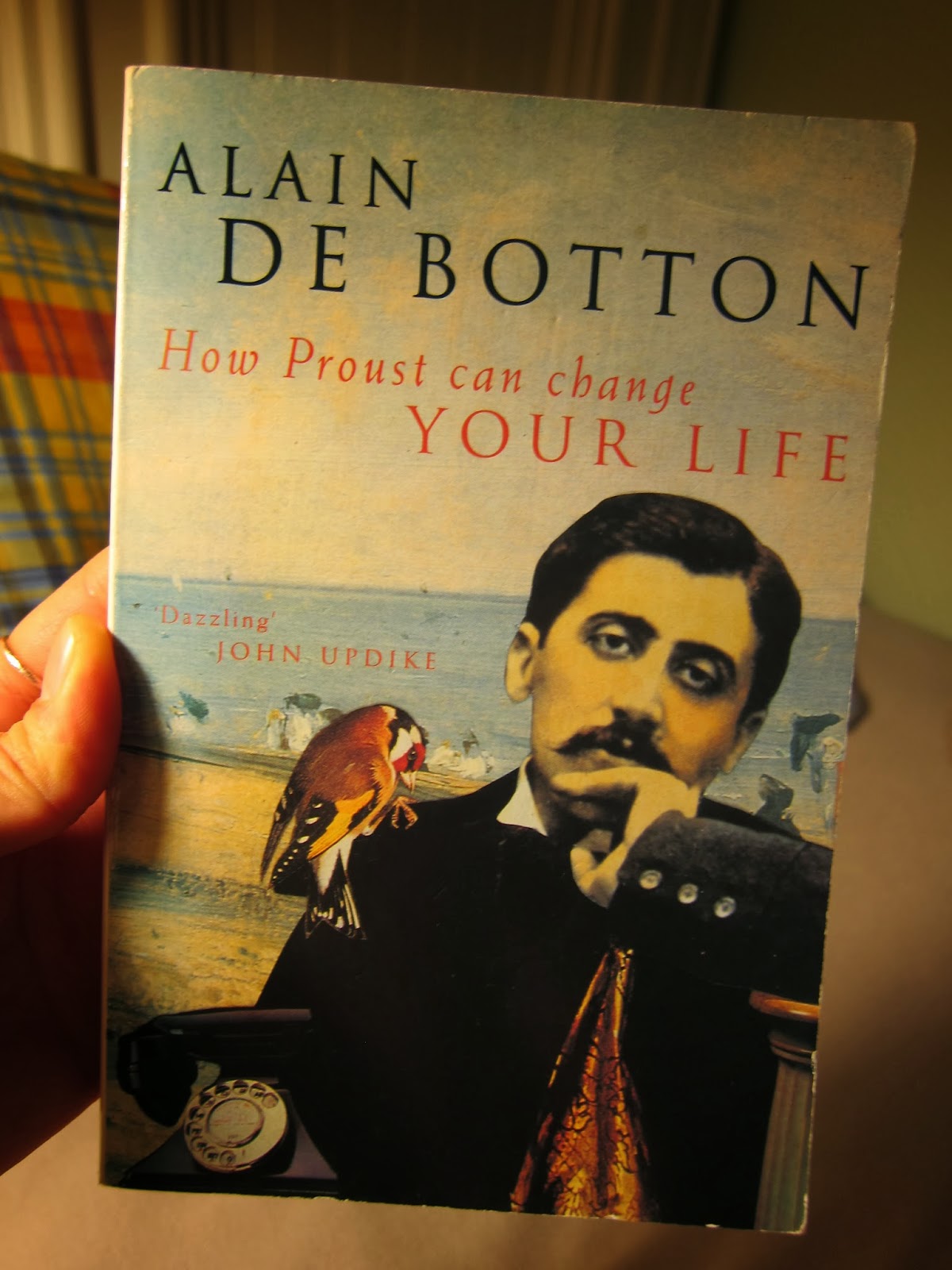
How Proust Can Change Your Life --Alain de Botton

My legs were uncomfortabl(ly warm)e so I slipped them out from under the covers.
Then my teeth were uncomfortabl(ly tight)e in their retainers so those got slipped out, too.

the following quotations are from here
(what the...there are youtube renditions of this)

How to Put Books Down:
"...we should be reading for a particular reason: not to pass the time, not out of detached curiosity, but out of a dispassionate wish to find out what Ruskin felt, but because, to repeat with italics, "there is no better way of coming to be aware of what one feels oneself than by trying to recreate in oneself what a master has felt." We should read other people's books in order to learn what we feel; it is our own thoughts we should be developing even if it is another writer's thoughts that help us do so. A fulfilled academic life would therefore require us to judge that the writers we were studying articulated in their books a sufficient range of our own concerns, and that in the act of understanding them through translation or commentary, we would simultaneously be understanding and developing the spiritually significant parts of ourselves.

And therein lay Proust's problem, because in his view, books could not make us aware of enough of the things we felt. They might open our eyes, sensitize us, enhance our powers of perception, but at a certain point they would stop, not by coincidence, not occasionally, not out of bad luck, but inevitably, by definition, for the stark and simple reason that the author wasn't us. There would come a moment with every book when we would feel that something was incongruous, misunderstood, or constraining, and it would give us a responsibility to leave our guide behind and continue our thoughts alone...

It is one of the great and wonderful characteristics of good books (which allow us to see the role at once essential yet limited that reading may play in our spiritual lives) that for the author they may be called "Conclusions" but for the reader "Incitements." We feel very strongly that our own wisdom begins where that of the author leaves off, and we would like him to provide us with answers when all he is able o do is provide us with desires... That is the value of reading, and also its inadequacy. To make it into a discipline is to give too large a role to what is only an incitement. Reading is on the threshold of the spiritual life; it can introduce us to it: it does not constitute it. 

It obliges us to read with care, to welcome the insights books give us, but not to subjugate our independence or smother the nuances of our own love life in the process.

Otherwise, we might suffer a range of symptoms that Proust identified in the overreverent, overreliant reader:

.........

Symptom No. 2: That we are unable to write after reading a good book:
Reading Proust nearly silenced Virginia Woolf... "Proust so titillates my own desire for expression that I can hardly set out the sentence. Oh if I could write like that! I cry. And at the moment such is the astonishing vibration and saturation that he procures -- there's something sexual in it -- that I feel I can write like that, and seize my pen and then I can't write like that." 

"I detest my own volubility. Why be always spouting words?"

"This is the worst time of all. It makes me suicidal. Nothing seems left to do. All seems insipid and worthless."

"[In Search of Lost Time] which is of course so magnificent that I can't write myself within its arc. For years I've put off finishing it; but now, thinking I may die one of these years, I've returned, and let my own scribble do what it likes. Lord what a hopeless bad book mine will be!"

The tone suggests that Woolf had at last made her peace with Proust. He could have his terrain, she had hers to scribble in. The path from depression and self-loathing to cheerful defiance suggested a gradual recognition that one person's achievements did not have to invalidate another's, that there would always be something left to do even if it momentarily appeared otherwise. Proust might have expressed many things well, but independent thought and the history of the novel had not come to a half with him. His book did not have to be followed by silence; there was still space for the scribbling of others, for Mrs. Dalloway, The Common Reader, A Room of One's Own, and in particular, there was space for what these books symbolized in this context -- perceptions of one's own."


--------------------------------the application:------------------------------


These are layers and layers of genius to grapple with, learn from, and irreverently throw aside after having ingested their healthy juices. As healthy and addictively refreshing as regular bowel movements, a happy colon with a diet full of fiber. 

I feel like I am learning how to read from this book. The best kinds of teachers are the ones you can leave behind, aren't they? No matter how good their handwriting, no matter how ingenious their analysis of To the Lighthouse, no matter how inferior you feel in their presence -- actually, the best, the most effective, the most truly inspirational of all teacherly beings are the ones who allow you to stand on their shoulders and look into worlds beyond their own scope. Teachers with teachings that are great enough to cause those heart tremors, but humble enough to allow for the possibility of greater, fiercer vibrations. 

Those who equip us with the real tools, of believing in the distinct realizability of our loftiest dreams. In made-up words and over-hyphenization, allll included. 

"Lord what a helpless bad book mine will be!"

There 
are unbreathed, disquieted rumblings on the insides of my insides. I can't wait to read A la recherche de temps perdu. I can't wait to finish it and to put it down and then to poop out my own poop (...sorry; stop thinking about it...now!). But for now, it's legs-under-the-covers and retainers, back on: getting prepared for the good work of tomorrow and tomorrow's tomorrow's tomorrows.

Tuesday, December 17, 2013

familiarity engineerity

There are things that make me drool in awe in familiar ways, such as this:

unfortunate frame, but this is Sarah Kay on TED!

By familiar, I mean reaching into well-worn corners of my heart down oft-trodden roads. Feelings I'm used to feeling, inspired by thing I'm used to being inspired by. Things in this category include: KMaus's Shakespeare lectures, learning human lessons through unexpected/old literature, my mom's compassion for the randomest (sometimes, in my selfish opinion, undeserving) things, Binky staring lovingly and meaningfully at the twinkling lights on our Christmas tree, and spoken poetry. See above. These are things that often and expectedly and familiarly tug at my heartstrings, by virtue of the fact that I am emotionally-inclined (rather than logical), that I am a big-picture person (rather than details), that I am an English major, etc. etc.

But then there are times when the odd engineer will truly, seriously inspire me. Not just through vicarious excitement through their excitement for a science-y, tech-y project of theirs, but through genuine (if shallow) sharing. Really taking the time to explain to me what, when, how, and why they do the work they do, what they are learning in which obscure- and scary-sounding course this semester, and how these things will change the world.

Then I realize (again and again and again) why we are meant to live in society; how we are such inevitably social creatures. Because one person can't handle all these fantastic and confusing things alone; one isn't enough to figure out the mysteries of the planets and intricacies of the human psyche and be a mad poet (usually) - we need each other, to access these unfamiliar corners of the wonder that is This World, given to us wrapped in a great big red bow of Christmasesque cheer, not corny, just true. 

cause sometimes, engineers will surprise you with the kind of poetry they Favorite on youtube.

Tuesday, October 8, 2013

Thank you, God, for Gothic Literature

How do you navigate through life's struggles?
How do you pick your mate?
What is good? What is evil? What are we?
How do you deal with displacement and abandonment and that foreverlonely you feel in the pit of your stomach, no matter how much you try to squash it down with loud noises and bright lights and even seemingly-worthy Pursuits of Happiness?

"Literature answers philosophical questions with particulars. Novels throw a bunch of people together on a level playing field and have them work out these human problems."

And we watch and learn, laughing and crying and frowning in vicarious pain and joy and ah-hah moments.

That's why people believe in life-saving poetry and stuff. It's how terrible circumstances are redeemed as tools for recovery and encouragement; like how phoenixes rise from their own ashes and how beautiful flowers grow from poop.

Good words to think about on a melancholy Monday afternoon of a fourth-year fall semester.

Thank you, God, for literature.
Thank you, God, for this undergraduate path as an English major.
Thank you, God, for Mysteries of Udolpho and the weepy sensibilities of Emily St. Aubert and for saving us poor unfortunate souls from ourselves.

for a lucky few, life is not so struggley.
though maybe that's an unfair judgment from a haughty perspective.

Monday, May 2, 2011

"un moment émouvant"

My laptop is way too heavy to carry around to all of my classes. So I don't. Then I justify this with all sorts of excuses: "with a computer in class, I'll just be distracted!"..."taking notes by hand makes me feel like a real student!"..."motor memory...yay?!" (irrelevant when you can't read the notes afterwards because they are only a mass of sleepy scrawlings all over the notebook pages...sigh).

But...let's be real - the one true reason is that carrying my laptop around is cause it tips over the weight limit of my backpack from heavy to backbreaking. I have a weak back, I think.

But Thursday, April 28th was a day that truly made me regret this silly habit of never bringing my laptop to class. It was a day when I wished I could write as fast as I could type - to capture all the words falling from my French professor's mouth, from her brilliant brain.

FREN 3032 was my daily inspirations class of the semester. I mistakenly thought it was going to be taught by a TA, but it turns out that Claire Lyu is not only NOT a TA, but a science genius tri-lingual lover of French poetry - basically the adult I want to be when I grow up. And on this past Thursday, our last real class of the semester since we're taking our final test on our actual last class, she was more full of beautiful words than usual. She wanted to send us off on...good feet, I think. Or something. Obviously I am far from the eloquence that is my French professor.

She said that she had experienced "un moment émouvant" - an emotional moment, a touching moment - the night before, while reading this collection of literary criticisms. The passage she wanted to share with us was about the song of a bird. I know it sounds super sappy, but no worries because honestly I didn't get it all either and thusly will not expound upon it...hahaha. But she was talking about how powerful some literature can be - how some works have the ability to switch up the power dimensions of a relationship you can have with it ( :P kind of like this). Usually when you're reading something, you're in power. The subject is you and the object is it. You hold it, open it up on the webpage, pick up the book that contains it and control it. You read it and judge it and analyze it and finally pronounce that it is good or rather bad or quite mediocre, while it sits quietly and looks up at you and simply exists. Naked and vulnerable.

But...Claire Lyu shared with us that some works of literature take that power position away from you. Totally and surprisingly. You had no idea it would happen, but then there you are - suddenly pierced through the heart and defenseless, and the thing is staring at you instead of you looking at it. Suddenly it knows your heart and what you love and hate and mediocrely like. And to sum it up, she read to us from the book. That

"On ne sorte pas indemne de ce gen de livre."
"One does not escape unscathed from such a book."

And that that's why we study literature. Because sometimes, it has this power to make us buckle at the knees and cry or laugh, or stay completely quiet. Because it has the power to make you reveal your soul to it and to others - and that is the difficulty of humanities classes (gross generalization - please excuse me). I know I (self-destructively) stand right alongside the engineering school kids when they joke about our School of "Arts and Crafts" classes, but truly, humanities classes are difficult in their own way. When you analyze a piece of literature, even in just discussing it, you're revealing a piece of your soul: what you think about this piece of someone else's brain, heart, and how you believe it applies to your brain and heart. When you create a piece of art, you're undressing a little bit of your secret self and representing it concretely for whoever happens to walk by to see - it's bravery at its finest. When you write an essay, analyzing and synthesizing (at least when you do it right), you're investing a chunk of your brainwaves to this clean slate of paper and bringing into being not just some inky letters but an idea, a new thing, fresh and alive into the world. It's an emotional thing - you invest your heart in it a little (or a lot).

When was the last time you were brave enough to get naked for a math equation? Do molecular structures inspire you to tears or pierce through your heart or render you completely helpless and reveal a part of your soul (not counting those times when you despaired like a baby because you didn't get the concept)?

These are the questions and affirmations that Claire Lyu inspired on the second to last day of my French class. As we all responded in the various ways that we usually do - from yawning to acting cool/like we understand everything she just said to sitting on the chairseat edges trying to engrave into our minds every pearly bead of wisdom that fall from her mouth - Madame Lyu remarked that maybe it's because of all the talk of bird songs, but that she felt like a mama bird letting all her babies fly out of the nest.

buh-bye!
And with that image, I said a bittersweet goodbye and floated out of room. Feeling broken into, a little bit taken by surprise, and a tiny bit...more naked than I had felt going into class on that fateful Thursday afternoon.